How to Build Confidence in Children: A Parent's Guide
Table of Contents
- How to Build Confidence in Children: Start With the Right Foundation
- Confidence-Building Activities for Kids That Actually Work
- Positive Parenting Phrases for Confidence (and What to Avoid Saying)
- How Martial Arts Build Confidence in Kids
- How to Encourage a Shy Child Without Pushing Too Hard
- Common Mistakes Parents Make When Building Confidence
- When to Get Help: Signs Your Child Needs More Support
- Frequently Asked Questions
Last Updated: October 20, 2026
How to Build Confidence in Children: Start With the Right Foundation
Confidence in children is not something you hand over in a single talk. It grows from repeated small wins, steady routines, and adults who respond with warmth instead of pressure. At Great Way Martial Arts in Kelowna, BC, we have taught kids since 1993, and one pattern holds true: children build confidence through practice, not praise alone.
The first step is to understand what confidence actually is.
Confidence Is a Skill, Not a Personality Trait
Confidence is the learned ability to try something difficult and handle the outcome, whether it works or not. That means any child can build it. Shy kids, cautious kids, and kids who quit easily are not "born that way." They simply have not practiced the skill yet.
This reframing matters. When you treat confidence as a skill, you stop waiting for your child to "come out of their shell." Instead, you give them chances to practice.
A few foundations to set early:
- Let your child make small choices, like picking their own clothes or snack.
- Praise effort and process, not natural talent.
- Let them solve age-appropriate problems before you step in.
- Keep routines predictable so they know what to expect.
Confidence-Building Activities for Kids That Actually Work
The best confidence-building activities for kids share one feature: they stretch a child slightly past their comfort zone, with support nearby. Easy wins feel nice but teach little. Overwhelming challenges teach kids to quit.
Try these:
- Chores with real responsibility. Carrying groceries or setting the table shows a child they contribute.
- Structured physical activity. Sports, martial arts, or swimming give clear progress markers.
- Show-and-tell at home. Let your child teach you something they know.
- Cooking together. Following a recipe builds focus and gives a visible result.
- Small social tasks. Ordering at a counter or asking a store clerk a question.
The key is repetition. One successful attempt is nice. Ten of them start to change how a child sees themselves.
Positive Parenting Phrases for Confidence (and What to Avoid Saying)
Positive parenting phrases for confidence focus on effort, choices, and growth. The words you use daily shape how your child talks to themselves.
Phrases that help:
- "You worked hard on that."
- "Tell me how you figured it out."
- "That was a brave try."
- "What would you do differently next time?"
- "I noticed you kept going even when it got hard."
Phrases to avoid:
- "You're so smart." This ties worth to a fixed trait.
- "Don't be scared." This dismisses the feeling instead of addressing it.
- "Let me do it." This removes the practice.
- "Why can't you be more like your brother?" Comparison erodes confidence fast.
The difference is subtle but real. Praise the process and the child learns that effort matters. Praise the trait and the child learns that failure is a verdict.
How Martial Arts Build Confidence in Kids
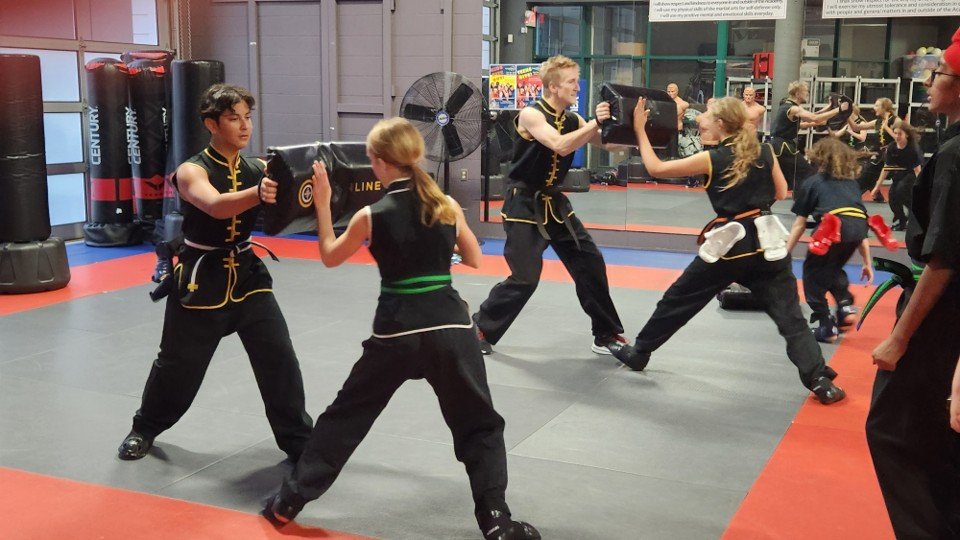
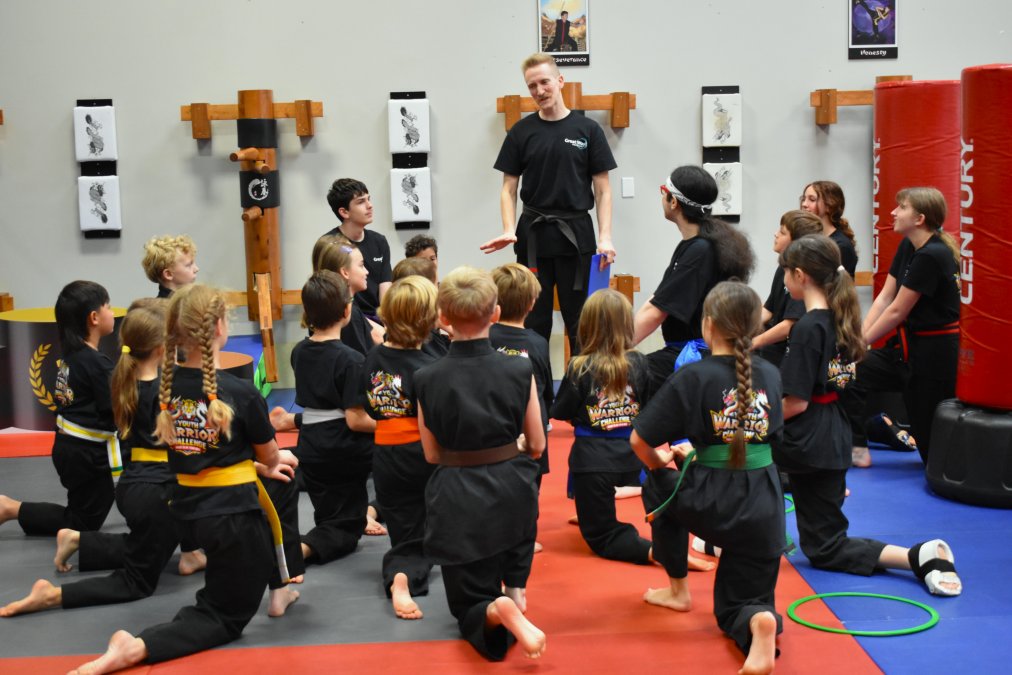
Martial arts build confidence in kids because the training itself is a series of small, measurable wins. A child learns a stance, then a strike, then a short form. Each step is visible, and each one earns the next.
A young child in a martial arts uniform practicing a low stance with a supportive instructor kneeling nearby in a bright training hall, other children watching and smiling
Mastering these physical disciplines provides a tangible framework for growth that complements other proven confidence strategies designed to foster resilience in everyday life.
At Great Way Martial Arts, our career instructors use a systematized goal-setting system. Kids see what they are working toward and what comes next. We also use Brain Gym and Mindset Training to help students manage nerves, focus, and self-control.
The structure matters. Kids who struggle with competition often thrive here because progress is measured against their own last attempt, not against the child beside them.
Why Wing Chun Suits Kids Who Don't Like Competition
Wing Chun is a close-range style built on structure, sensitivity, and control rather than raw force. That makes it a good fit for kids who dislike loud, aggressive environments.
The style rewards patience and precision. A smaller child can learn to redirect force rather than overpower an opponent. There are no tournaments, no travel, and no pressure to win medals. Our programs, from Kung Fu Cubs for ages 4-5 up through Teen Martial Arts, are designed to meet kids where they are.
How to Encourage a Shy Child Without Pushing Too Hard
Encouraging a shy child starts with lowering the pressure, not raising it. Pushing a hesitant child into the spotlight usually backfires. They learn that the thing they feared was as bad as they thought.
Try this approach instead:
- Give warning before new situations. "In ten minutes, we'll meet the instructor."
- Stay nearby at first, then step back gradually.
- Let them watch before joining. Observation is a form of participation.
- Praise the attempt, not the outcome.
- Avoid labeling them as "shy" in front of others.
Shyness is not a flaw to fix. It is a temperament to work with. Many shy kids become confident adults when adults give them time and a safe structure.
Common Mistakes Parents Make When Building Confidence
The biggest mistake is doing too much for a child who could do it themselves. It feels helpful in the moment, but it quietly tells the child, "You can't handle this."
Other common missteps:
- Praising only outcomes. A child learns that second place is failure.
- Rescuing too fast. Let them struggle a little before stepping in.
- Comparing siblings or classmates. Comparison breeds doubt, not drive.
- Ignoring their interests. Confidence grows fastest around things a child actually enjoys.
- Over-scheduling. Kids need unstructured time to make their own choices.
When to Get Help: Signs Your Child Needs More Support
Most confidence struggles are normal and pass with time and practice. Some signs suggest your child needs more support than a parent can provide alone.
Watch for:
- Withdrawal from activities they used to enjoy
- Frequent stomachaches or headaches before school or social events
- Refusing to try anything new, even low-stakes things
- Harsh self-talk that lasts for weeks
- Trouble making or keeping friends
Talk to your family doctor or your child's school if these signs persist. In Canada, provincial health services and school counselors can point you toward child and youth mental health supports.
For everyday confidence building, structured activities with consistent adult mentors help. That is where programs like ours come in.
Building confidence in children is a long game, and it works best with steady practice, patient adults, and the right environment. If your child needs a place to grow that skill week after week, Great Way Martial Arts has been doing exactly that in Kelowna since 1993. Our year-round registration, beginner-friendly classes, and competition-free approach give kids a safe place to try, fail, and try again. Get started with Great Way Martial Arts and watch your child build confidence one small win at a time.
Frequently Asked Questions
How can I help my child become more confident?
Start small and let your child succeed at achievable tasks. Praise effort rather than outcome, and give them age-appropriate responsibilities at home. Enroll them in structured activities like Wing Chun classes where they can track progress through a goal-setting system. At Great Way Martial Arts in Kelowna, kids work through a step-by-step curriculum that builds confidence gradually. Consistency matters more than intensity, so aim for short, regular practice rather than occasional big pushes.
What activities help build confidence in children?
Activities that combine clear goals, repetition, and supportive feedback work best. Martial arts, swimming, music lessons, and team sports all give kids a chance to see improvement over time. Confidence-building activities for kids should match their learning style. Visual learners benefit from demonstrations, auditory learners from verbal cues, and kinesthetic learners from hands-on practice. Wing Chun classes at Great Way Martial Arts are designed to reach all three learning styles, which helps every child feel capable.
How do martial arts build confidence in kids?
Martial arts build confidence through repeated small wins. Each class gives kids a clear skill to practice, immediate feedback from an instructor, and a visible sign of progress like a new belt or technique. Over time, children learn that effort leads to improvement, which is the core of self-belief. A non-competitive environment removes the fear of losing, so kids focus on their own growth. Great Way Martial Arts uses a systematized goal-setting system and Mindset Training to reinforce this process.
How do I encourage a shy child without pushing too hard?
Respect their pace. Offer new experiences in small doses and let them watch before joining. Use positive parenting phrases for confidence such as 'You can take your time' and 'I'm here while you try.' Avoid labeling them as shy, which can become a fixed identity. Enroll them in a beginner-friendly class where instructors are trained to work with different temperaments. Great Way Martial Arts welcomes new students year-round and instructors adapt to visual, auditory, and kinesthetic learners.