How to Choose a Martial Arts School: A 2026 Guide
Table of Contents
- Start With Your Goals, Not the Style
- Martial Arts Classes for Beginners: What to Look For
- What to Expect in a First Martial Arts Class
- The Real Cost of Martial Arts Training in Canada
- Safety, Hygiene, and Facility Standards
- Red Flags That Should End the Conversation
- What Competitors Miss: Insurance, Liability, and Injury Protocols
- Conclusion
- Frequently Asked Questions
Last Updated: September 16, 2026
Start With Your Goals, Not the Style
Most people searching for how to choose martial arts school options begin with the wrong question. They ask "karate or kung fu?" when the better question is "what do I actually want to change?" A parent in Kelowna wants a child who listens at home. An adult wants stress relief and self-defense. Those goals point to different programs, even inside the same building.
Define your training objectives before you tour anything:
- Physical conditioning - weight loss, flexibility, strength, stamina
- Self-defense - practical skills you can apply under pressure
- Mental discipline - focus, patience, emotional regulation
- Community - a social outlet and a place where people know your name
Martial Arts Classes for Beginners: What to Look For
Martial arts classes for beginners should teach fundamentals to people with zero background, at a pace that builds skill acquisition without overwhelming anyone. If a school's beginner program assumes prior experience, it isn't a beginner program.
Instructor Lineage and Credentials
Instructor lineage is the verifiable chain of teachers behind your instructor: who trained them, under whom, and for how long. Ask directly. A credible instructor can name their teacher and their teacher's teacher without hesitation.
- Rank or belt progression documented through a recognized organization
- Teaching experience with your age group, not just adult classes
- First aid training and a clear safety protocols framework
- Longevity at the school itself
Student-to-Instructor Ratios and Class Structure
A student-to-instructor ratio above roughly 15:1 means your child spends most of the class waiting. For beginners, especially younger ones, look for closer to 8:1 or 10:1.
What to Expect in a First Martial Arts Class
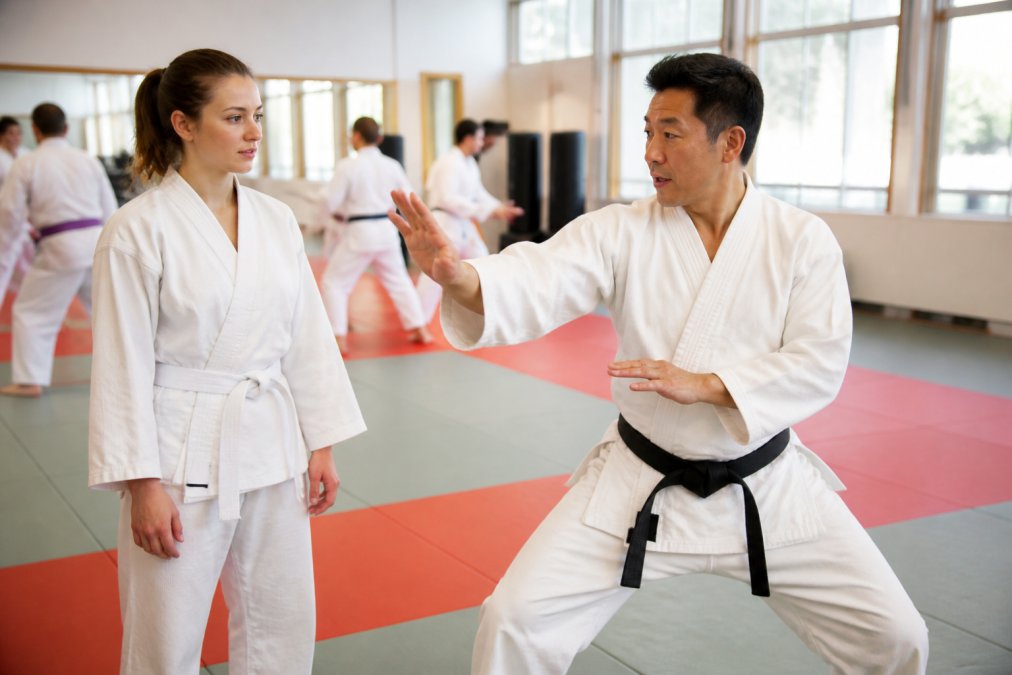
A first martial arts class typically runs 45 to 60 minutes and includes a warm-up, basic technique instruction, partner or pad work, and a cool-down. Beginners should expect to feel awkward. That is normal and expected.
What a Good Beginner Class Actually Looks Like
Watch for these mechanics during the session:
- A structured warm-up that prepares the specific joints and muscles the class will use, not a generic jog
- Demonstration before drilling, the instructor shows the technique, then watches students attempt it
- Individual correction, the instructor moves through the room and adjusts at least a few students by name
- Progressive difficulty, the class builds from simple to more complex within the hour
- A cool-down and a clear ending, students leave knowing what they practiced and what comes next
If the instructor spends the hour demonstrating from the front without walking the floor, beginners are not getting corrected, and uncorrected repetition builds bad habits.
Questions to Ask During Your Trial Class
Bring these to your visit and expect direct answers:
- How long has this specific instructor been teaching here?
- What does the belt progression timeline actually look like for a beginner?
- Are belt testing fees included in tuition or billed separately?
- What happens if my child is injured or needs to pause training?
- Can I observe a regular class, not just a staged introductory program?
- How do you handle a student who is struggling or losing motivation?
- What is your cancellation and refund policy in writing?
If any answer feels evasive, treat that as information.
Red Flags to Watch For During the Visit
Some warning signs are worth walking away from immediately, regardless of how good the class looked:
- No written contract or pricing, if terms are verbal only, you have no protection
- Guaranteed black belts, real belt progression reflects demonstrated skill, not a payment plan
- Instructors who won't name their lineage, evasiveness about credentials is a hard stop
- High-pressure same-day enrollment tactics, legitimate schools let you think
- No trial class offered, you should never buy training you haven't experienced
- Disorganized, chaotic classes, a class that can't hold structure won't teach discipline
- Instructors who yell or shame students, particularly damaging for children
- No clear policy on injuries or refunds, you need to know what happens when things go wrong
The Digital Footprint Check
Before you leave the parking lot, pull up the school's reviews on independent platforms and its social media. Look for recent activity, not just a polished website. Check whether instructors appear in staff bios that have been updated recently. A school with high turnover shows it online, and a school that hides its staff page is telling you something.
The Real Cost of Martial Arts Training in Canada
The cost of martial arts training in Canada varies widely by program, frequency, and city, so there is no single national figure worth quoting. What matters is comparing total annual cost, not the headline monthly rate, and understanding the fee mechanics that let a school advertise a low number while collecting far more over twelve months.
The Fee Categories That Actually Drive Your Annual Cost
- Monthly tuition, the advertised number, usually the smallest part of the total
- Registration or enrollment fee, often charged annually, sometimes non-refundable
- Uniform and required equipment, a gi, belt, gloves, shin guards, or a school-branded shirt can add up quickly, and some schools require you to buy from them only
- Belt testing or grading fees, frequently charged per promotion, and the single most common source of cost surprise
- Seminars, camps, and tournaments, often framed as optional but sometimes required for advancement
- Cancellation, pause, and transfer fees, what it costs to stop or freeze training
A lower monthly rate with frequent testing fees can cost more over a year than a higher flat rate. Request the annual total before you commit.
How to Read the Contract
Look for:
- A written contract, not a verbal agreement
- A clear cancellation clause stating notice period and any fees
- A stated refund policy for unused time
- Whether the contract auto-renews and how to stop it
- Whether you can pause for illness, injury, or travel, and for how long
If a school won't put terms in writing, that is your answer.
The Digital Footprint Check Most Guides Skip
Before you accept any price, verify the school's reputation outside its own marketing. Read recent reviews on independent platforms, not just testimonials on the school's site. Check whether instructor bios have been updated recently, a school with high turnover shows it online, and a school that hides its staff page is telling you something. Look for patterns in complaints about billing, cancellation, or refunds specifically; those are the disputes that show up in reviews and rarely in a school's own materials.
provincial consumer protection office contact list
Safety, Hygiene, and Facility Standards
Mat hygiene separates professional schools from casual ones. Ask how often mats are cleaned, whether students train barefoot or in shoes, and what the policy is for skin infections.
- Mats cleaned and disinfected on a posted schedule
- Adequate ventilation and clean change areas
- Equipment inspected and replaced, not frayed and taped together
- A visible first aid kit and staff trained to use it
- Injury prevention built into warm-ups, not skipped when class runs late
Red Flags That Should End the Conversation
Some warning signs are worth walking away from immediately, regardless of how good the class looked.
- No written contract or pricing - if terms are verbal only, you have no protection
- Guaranteed black belts - real belt progression reflects demonstrated skill, not a payment plan
- Instructors who won't name their lineage - evasiveness about credentials is a hard stop
- High-pressure same-day enrollment tactics - legitimate schools let you think
- No trial class offered - you should never buy training you haven't experienced
- Disorganized, chaotic classes - a class that can't hold structure won't teach discipline
- Instructors who yell or shame students - particularly damaging for children
- No clear policy on injuries or refunds - you need to know what happens when things go wrong
What Competitors Miss: Insurance, Liability, and Injury Protocols
Insurance and liability are the least-discussed and most important questions in this entire process, and most guides never mention them. A reputable school carries liability insurance. Ask what coverage exists for students injured during class.
Conclusion
Choosing a martial arts school is a decision about trust, and the schools that earn it will answer every question above without hesitation. Great Way Martial Arts has taught in the community since 1993 with full-time career instructors, a competition-free environment, and a curriculum built around goal-setting, mindset training, and learning styles that fit every student. Explore our programs for children, teens, and adults, or book a trial class and see the difference for yourself.
Frequently Asked Questions
How do I pick the right martial arts school for my child?
Start by watching a class without your child present. Look at how instructors correct mistakes, whether students seem engaged, and if the space is clean. Ask about instructor tenure and whether they teach full-time or as a side job. A good martial arts school will let you observe, answer questions about curriculum and belt progression, and offer a trial class before you commit to a contract.
What qualifications should I look for in a martial arts instructor?
Ask about instructor lineage, years of teaching experience, and whether they hold certifications in coaching or child development. Full-time career instructors who teach daily tend to have more consistent methods than part-time staff.
What should I expect in a first martial arts class?
Most introductory programs include a warm-up, basic stance and movement drills, and a simple technique or two. You should get individual attention, not just be left to copy others. Ask beforehand about equipment requirements and uniform costs so you arrive prepared. A well-run first class ends with clear feedback on what you did well and what to practice next.
How much does martial arts training cost in Canada?
The cost of martial arts training in Canada depends on the school, program length, and what is included. Monthly fees, belt testing fees, uniform costs, and equipment requirements all add up. Ask for a full breakdown before signing. Some schools bundle everything into one rate; others charge separately. Request the total first-year cost in writing so there are no surprises.
What are the biggest red flags when choosing a martial arts school?
Watch for pressure to sign a long contract on day one, no trial class option, instructors who cannot explain their lineage or training, dirty mats or equipment, and schools that guarantee a black belt in a fixed time. Also be wary if no one can tell you what happens if a student gets injured during sparring.
Should I choose a school based on proximity or the style taught?
Proximity matters more than most beginners expect. A school 45 minutes away becomes a barrier after a few months. Pick a location you can reach in 20 minutes or less, then compare styles within that radius. If your preferred style is only available farther away, try a nearby school's trial class first to see if their approach fits your training objectives.