Is Martial Arts Good Exercise? Benefits for All Ages
Table of Contents
- Why Martial Arts Is Excellent Exercise
- Physical Fitness Gains From Martial Arts Training
- Mental Health Benefits of Martial Arts
- Martial Arts vs Gym Workout: Which Is Right for You
- Benefits of Kickboxing for Weight Loss and Conditioning
- Building Discipline, Confidence, and Life Skills
- Getting Started With Martial Arts at Any Age
- Frequently Asked Questions
Last Updated: October 15, 2026
Why Martial Arts Is Excellent Exercise
Is martial arts good exercise? The short answer is yes, and it's far more comprehensive than most traditional workouts. Martial arts combines cardiovascular conditioning, strength training, flexibility work, and coordination development all in one structured practice. At Great Way Martial Arts, this integrated approach delivers results that isolated gym routines often miss.
What sets martial arts apart from generic fitness is the systematic progression built into the training itself. You're not just repeating the same movements; you're building toward specific goals with measurable milestones. Your body adapts to increasingly complex techniques, which means your fitness gains compound over time rather than plateau.
The engagement factor matters too. When you're focused on mastering a new form or perfecting a technique, you're not watching the clock. The workout passes quickly because your mind is actively engaged, not just enduring repetition.
Physical Fitness Gains From Martial Arts Training
Martial arts training builds functional fitness that transfers directly to daily life. Unlike isolated muscle work at a gym, you develop strength, endurance, and mobility in patterns your body actually uses. Your core stabilizes during kicks and strikes. Your legs generate power from the ground up. Your shoulders and arms work through full ranges of motion, not just in one plane.
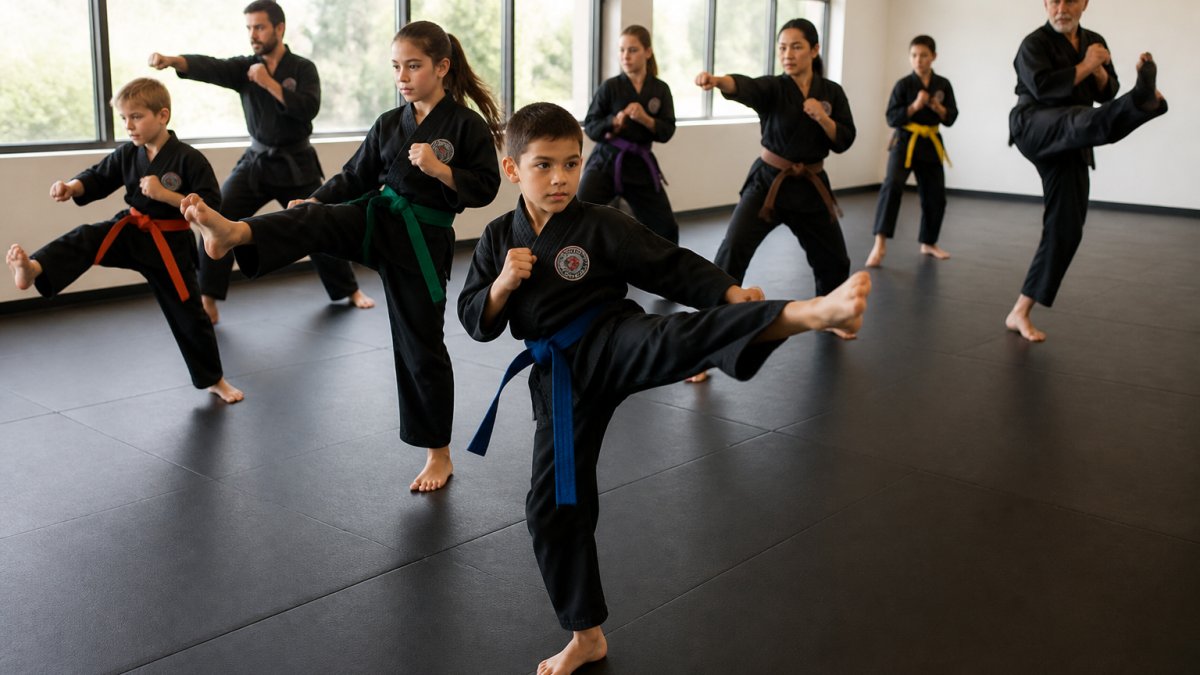
Cardiovascular conditioning happens naturally through the intensity of training. High-intensity interval techniques, like the H.I.I.T. Kickboxing classes offered at Great Way Martial Arts, push your heart rate up and down repeatedly, which builds aerobic and anaerobic capacity simultaneously. This type of training is effective for cardiovascular adaptation.
Flexibility and range of motion improve significantly. Kicks require hip mobility that most people lack. Punching combinations demand shoulder flexibility. Over weeks of consistent practice, your joints move more freely and your muscles lengthen.
Balance and proprioception, your body's sense of where it is in space, develop through constant practice (pubmed.ncbi.nlm.nih.gov). Standing on one leg while throwing a kick, shifting weight during combinations, and maintaining stance all require your nervous system to make constant micro-adjustments. This carries over to reduced fall risk and better athletic performance in other sports.
Mental Health Benefits of Martial Arts
The mental health impact of martial arts training often exceeds the physical gains. The practice demands focus that quiets the noise of daily stress. When you're concentrating on executing a technique correctly, worries about work or other pressures fade into the background. This meditative quality provides genuine stress relief, not just distraction, but active mental engagement that resets your nervous system.
Confidence builds through measurable progress. You start as a beginner, uncertain of basic movements. Within weeks, you perform techniques that seemed impossible at the start. Within months, you've mastered forms and combinations. This progression creates genuine self-efficacy, the knowledge that you can learn difficult things through consistent effort. That confidence extends beyond the training hall into school, work, and social situations.
Discipline develops as a byproduct of the structure. Martial arts training requires showing up regularly, following instruction, and practicing techniques you find difficult. This systematic approach to improvement becomes a mindset you apply elsewhere. Students often report better focus at school or work, improved time management, and greater persistence when facing challenges.
The supportive community aspect matters more than many realize. Training alongside others who are on their own journeys creates a sense of belonging. You're not competing against classmates; you're all working toward individual goals in a shared environment. This non-competitive structure, which Great Way Martial Arts emphasizes, removes the anxiety that competitive environments create for many people.
Martial Arts vs Gym Workout: Which Is Right for You
A traditional gym focuses on isolated muscle development through repetitive movements. You target specific muscles with machines or free weights, building strength in a controlled environment. This approach works well if your goal is pure muscle size or if you have limited time and want efficiency. However, the repetition can become boring, and the isolation doesn't develop the functional, full-body coordination that daily life requires.
Martial arts training develops full-body integration. Every technique involves your entire kinetic chain, feet, hips, core, shoulders, and arms working together. You're building strength in functional patterns, not isolated muscles. Your nervous system learns to coordinate complex movements, which improves athletic performance across multiple activities.
The gym typically offers consistency and measurable progress in specific metrics: weight lifted, reps completed, or machines used. Martial arts offers measurable progress too, new techniques mastered, forms completed, goals achieved, but the metrics are broader and more skill-based.
For stress relief, the gym can feel transactional: you go, complete your workout, and leave. Martial arts creates a ritual and community. The structure of class, the focus required, and the supportive environment combine to produce deeper stress relief than most gym sessions.
Many people find that martial arts is good exercise precisely because it addresses multiple needs simultaneously: physical fitness, mental clarity, skill development, and social connection. A gym excels at one thing. Martial arts excels at many things at once.
Benefits of Kickboxing for Weight Loss and Conditioning
Kickboxing stands out as one of the most effective martial arts for weight loss and conditioning. The high-intensity nature of the training burns significant calories during the session itself, and the intensity triggers metabolic effects that continue after you finish.
The full-body engagement of kickboxing means you're using large muscle groups repeatedly. Kicks engage your legs, hips, and core. Punches activate your shoulders, chest, and arms. The combination of upper and lower body work, performed at intensity, creates a metabolic demand that's difficult to achieve with isolated exercises.
Kickboxing for weight loss works because the training is engaging enough that people stick with it. Kickboxing is inherently interesting, you're learning techniques, improving coordination, and feeling like you're developing a real skill. That engagement translates to consistency, and consistency is what drives results.
The conditioning benefits extend beyond weight loss. Your cardiovascular system adapts to handle the demands of explosive movements and sustained effort. Your muscular endurance improves. Your power output increases. These changes happen because you're training your body to handle real-world demands, not just moving weight through space.
Building Discipline, Confidence, and Life Skills
Discipline in martial arts training isn't punishment; it's structure that produces results. You show up consistently, follow instruction, practice techniques that challenge you, and progress systematically. This structure creates discipline as a habit, not as something imposed from outside. Students internalize the idea that effort produces results.
Confidence emerges from this progression.
Life skills develop naturally through martial arts training. Respect for instructors and classmates becomes normal behavior. Listening carefully to instruction improves focus in other contexts. Setting and achieving goals becomes a practiced skill. Handling frustration when a technique doesn't work the first time teaches resilience. These skills transfer directly to school performance, workplace success, and relationships.
The non-competitive environment at Great Way Martial Arts makes this skill-building possible for everyone. In competitive martial arts, students focus on winning against others. In a non-competitive setting, students focus on improving themselves. That shift in focus removes anxiety and allows genuine learning and growth.
Getting Started With Martial Arts at Any Age
You don't need prior experience or exceptional fitness to start martial arts training. Programs like Kung Fu Cubs for ages 4-5 and Dragons for ages 6-7 introduce young children to movement, coordination, and basic discipline in a playful environment. These foundational classes build confidence and physical literacy that supports all future athletic pursuits.
Older children benefit from Champions Kung Fu, which develops more advanced techniques while maintaining the supportive, non-competitive environment. Teens find Teen Martial Arts programs that address their specific developmental needs, building confidence during a challenging life stage, providing structure and community, and offering a healthy outlet for energy and stress.
Adults often hesitate, assuming they're too old or too out of shape. In reality, martial arts training adapts to your current fitness level. You progress at your own pace. Traditional Wing Chun for Adults or H.I.I.T. Kickboxing for Adults offers the same benefits, improved fitness, mental clarity, skill development, regardless of your starting point. The instructors at Great Way Martial Arts work with each student's individual needs, not a one-size-fits-all template.
The best time to start is now. Whether you're looking for an activity for your child, a way to build your own fitness and confidence, or a supportive community to join, martial arts training delivers results. The key is finding a program with experienced instructors who prioritize your individual progress over competition or pressure. Starting is simpler than you think.
Is martial arts good exercise? The evidence is clear: it builds physical fitness, strengthens mental health, develops real-world skills, and creates community, all in one structured practice. Whether you're seeking better fitness, stress relief, confidence-building for your child, or a welcoming community to join, martial arts training in Kelowna offers a proven path forward. Great Way Martial Arts has supported students since 1993 through a systematized approach that emphasizes personal growth, individual goal-setting, and a supportive, non-competitive environment. Explore the programs available for your age and fitness level, and discover how martial arts training can transform your health and confidence.
Frequently Asked Questions
Is martial arts a good way to lose weight?
Yes. Martial arts training burns significant calories through continuous movement, striking combinations, and conditioning drills. Kickboxing and high-intensity interval training styles are particularly effective for weight loss because they combine cardiovascular work with resistance, elevating heart rate throughout the session. Results depend on consistency, intensity, and nutrition.
How does martial arts training improve mental health?
Martial arts reduces stress through focused, meditative movement and provides a structured environment where you can build confidence and self-control. The discipline required develops mindfulness, the goal-setting system builds resilience, and the supportive community aspect combats isolation.
Can beginners of any age start martial arts?
Absolutely. Martial arts welcomes beginners from age 4 through adulthood. Programs are structured by age and experience level, so you learn at your own pace without pressure to compete. Instructors adapt teaching methods to visual, auditory, and kinesthetic learners, making it accessible regardless of prior fitness or athletic background.
Is martial arts better than a traditional gym workout?
Both offer benefits, but they differ. Gyms excel at isolated muscle building and customizable strength training. Martial arts builds functional fitness, coordination, and mental discipline while delivering cardio and strength in one session. The key difference: martial arts provides structure, community, and life skills development alongside physical conditioning, making it ideal for those seeking holistic personal growth rather than pure muscle gain.