Is Martial Arts Good for Non-Athletes? A Beginner's Guide
Last Updated: October 22, 2026
Quick Summary
Yes, martial arts is good for non-athletes. Training starts from where your body is right now, not from an athlete's baseline, and builds strength, balance, and stamina in small steps. You do not need to get fit before you begin, because the training is how you get fit.
- Wing Chun rewards structure, relaxation, and timing rather than size, speed, or muscle.
- Most non-athletes do best with two classes per week, which allows recovery between sessions.
- Ten minutes of stance work at home between classes beats one long session.
- Beginner classes are competition-free, with no tournaments and no sparring before you are ready.
- Great Way Martial Arts in Kelowna has taught beginners since 1993 with year-round registration.
Table of Contents
- Is Martial Arts Good for Non-Athletes? Yes, and Here's Why
- Why Martial Arts for Beginners Beats Waiting Until You're Fit
- Wing Chun for Beginners: A Style Built for Real Bodies
- Martial Arts and Mental Focus: Training the Mind, Not Just the Body
- How Often to Practise Martial Arts as a Beginner
- What a Beginner-Friendly Class Looks Like in Kelowna
- Common Worries Non-Athletes Bring to Their First Class
- Conclusion: Start Where You Are
- Frequently Asked Questions
Is Martial Arts Good for Non-Athletes? Yes, and Here's Why
Yes, martial arts is good for non-athletes. In fact, it may be better suited to people who have never played a sport than to lifelong gym-goers. Martial arts training starts from where your body is right now, not from where an athlete's body is.
At Great Way Martial Arts in Kelowna, BC, we have taught beginners since 1993. Most people who walk through our door have never thrown a punch or held a stance. That is normal, and it is fine.
Here is the part most guides get wrong: you do not need to get fit before you start martial arts. The training is how you get fit. Waiting until you feel ready is the fastest way to never begin.
Below, we break down why martial arts suits real bodies, how Wing Chun works for total beginners, and what your first class actually looks like.
Why Martial Arts for Beginners Beats Waiting Until You're Fit
The biggest mistake beginners make is treating fitness as a prerequisite. It is not. It is a result.
Martial arts for beginners builds strength, balance, and stamina in small steps. You start with simple movements. You repeat them. Your body adapts. This is how physical skill has always been learned.
Compare that to a gym. A gym hands you equipment and a vague plan. A class hands you a coach, a routine, and a group doing the same thing beside you. For most non-athletes, that structure is the difference between quitting in three weeks and still training a year later.
According to ParticipACTION's Canadian fitness guidance, adults benefit from building activity gradually rather than jumping into intense routines. Martial arts fits that model well.
- No prior sport needed
- No baseline fitness test
- No pressure to keep up with athletes
- Progress measured against your own last class
Wing Chun for Beginners: A Style Built for Real Bodies
Wing Chun for beginners works because the style does not reward size or speed. It rewards structure, relaxation, and timing.
Wing Chun is a close-range Kung Fu system built around efficient movement. Power comes from body alignment rather than muscle. That makes it accessible to smaller people, older adults, and anyone who has never trained before.
What most guides miss is how forgiving the learning curve is. You practise short sequences. You repeat them until they feel natural. There is no requirement to kick above your head or spar on day one.
At Great Way Martial Arts, our Traditional Wing Chun For Adults program teaches the style step by step. Instructors adapt to visual, auditory, and kinesthetic learners, so you are not stuck if you learn by watching rather than listening.
- Simple stances you can hold at any fitness level
- Partner drills at controlled speed
- No competitions or tournaments
- Clear goals you can tick off as you improve
The style suits non-athletes because it asks for patience, not athleticism.
Martial Arts and Mental Focus: Training the Mind, Not Just the Body
Martial arts and mental focus go hand in hand. The same drills that build coordination also train attention, and that carries into work, school, and home life.
Think about what a class asks of you. You watch a movement. You copy it. You repeat it while a partner responds. Your mind cannot wander, because the drill stops working the moment it does.
That is focus training in disguise. Many students tell us they notice better concentration within weeks, not months.
Our instructors use Brain Gym and Mindset Training alongside the physical curriculum. These tools target self-control, patience, and kindness, not just technique. Goal setting is built in too: each student works through a structured system and sees progress in writing.
The Government of Canada's physical activity resources note that regular movement supports mental well-being. Martial arts adds the structure that makes movement a habit.
How Often to Practise Martial Arts as a Beginner
How often to practise martial arts depends on your starting point. For most non-athletes, two classes per week is the sweet spot.
Two sessions give your body time to recover between workouts. They also build a rhythm fast enough to see progress. Three classes a week suits people who already move regularly. One class a week works, but expect slower gains.
Here is a simple starting plan:
| Stage | Classes per Week | Focus | What to Expect |
|---|---|---|---|
| Weeks 1-4 | 2 | Learn basic stances and drills | Sore muscles, better sleep |
| Weeks 5-8 | 2 | Add partner work | Sharper coordination |
| Weeks 9-12 | 2-3 | Build flow and timing | Noticeable focus and stamina |
| Month 4+ | 2-3 | Refine technique | Steady progress, set goals |
Practise at home in short bursts too. Ten minutes of stance work between classes beats one long session. Consistency matters more than volume.
What a Beginner-Friendly Class Looks Like in Kelowna
A beginner-friendly class should feel structured, calm, and welcoming. If you walk into a Kelowna martial arts studio and feel like you have to prove something, that is the wrong room.
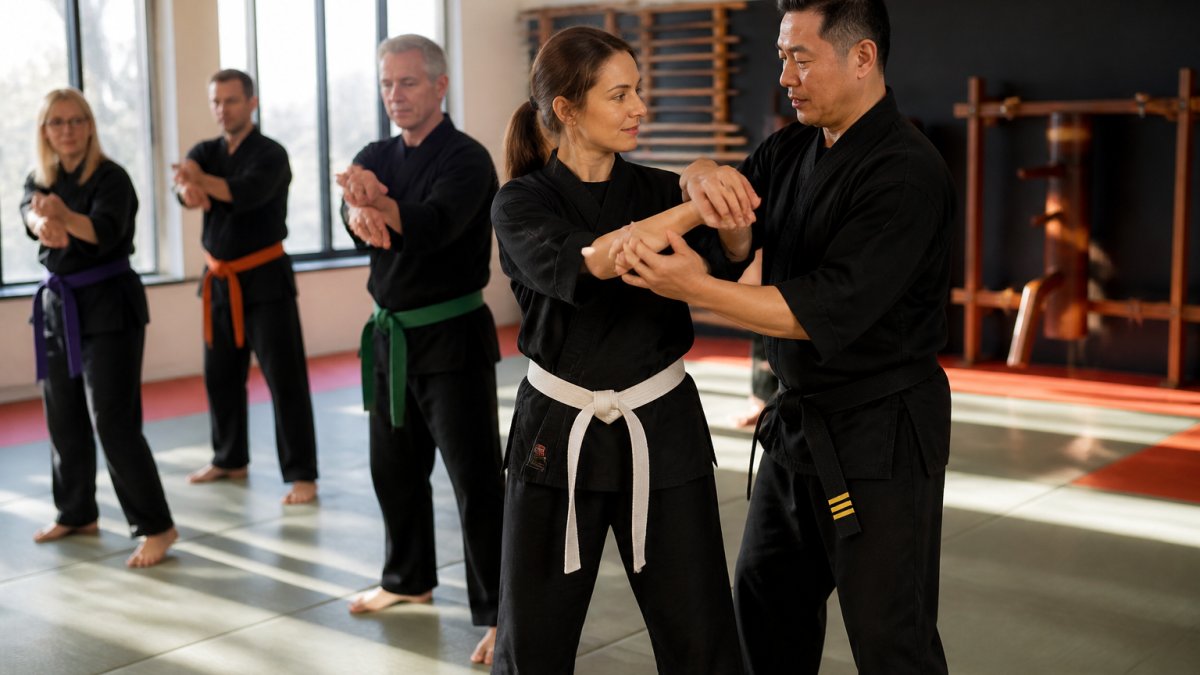
Here is what a good first class includes:
- A warm-up that matches your fitness level
- Clear instruction with demonstration, not just words
- Partner drills at slow, controlled speed
- Feedback from an instructor who knows your name
- A cool-down and a chance to ask questions
Our Kelowna studio has run full-time since 1993, with career instructors who stay long term. That matters for beginners. You build trust with a coach who is still there six months later.
We also work with Kids Sport Canada, Pacific Sport Okanagan, and Xplore Sports Camps. If you are searching for martial arts in Kelowna, visit us and watch a class before you decide.
Common Worries Non-Athletes Bring to Their First Class
Non-athletes arrive with the same handful of worries. Every one of them is reasonable, and every one has a practical answer.
"I'm not flexible enough." You do not need to be. Stances and drills build flexibility over time. Nobody expects a split on day one.
"I'll slow the class down." Beginner classes are built for beginners. Instructors teach to the room, not to the fastest person in it.
"I'm too old to start." Adults of all ages train with us. Wing Chun rewards relaxed, efficient movement, which suits older bodies well.
"I don't want to get hit." Our classes are competition-free. There are no tournaments, no travel, and no pressure to spar before you are ready.
"I'll quit like last time." Structure is the fix. Goal setting, steady coaching, and a supportive group keep people training when motivation dips.
Conclusion: Start Where You Are
The hardest part of martial arts is not the training. It is deciding that your current body is good enough to begin. It is.
Martial arts for non-athletes works because it meets you at your level and builds from there. You gain fitness, focus, and confidence in small, steady steps. Wing Chun makes that path even smoother, with technique that rewards structure over strength.
Great Way Martial Arts has taught beginners in Kelowna since 1993. Our career instructors use goal setting, Brain Gym, and Mindset Training in a competition-free studio, with registration open year round. You do not need to wait for a new session or get fit first.
Get started with Great Way Martial Arts and train at your own pace, with a coach who meets you where you are.
Frequently Asked Questions
Can you do martial arts if you are not athletic?
Yes. Martial arts training is designed to build the fitness you need rather than requiring it up front. A good beginner program starts with simple stances, basic footwork, and slow partner drills that raise your heart rate and build strength gradually. Non-athletes often make steady progress because the movements are taught step by step. At Great Way Martial Arts in Kelowna, classes cater to visual, auditory, and kinesthetic learners, so you are not expected to already know how to move.
Do you need to be fit before starting martial arts?
No. Waiting until you are fit is the most common reason people never start. Wing Chun for beginners focuses on structure, balance, and relaxed technique rather than high-impact conditioning, so fitness improves as a byproduct of regular practice. If you can walk up a flight of stairs, you can begin. Instructors adjust the pace and intensity, and you can sit out any drill that feels too much while you build capacity.
How often should a beginner practise martial arts?
Two classes per week is a realistic starting point for most non-athletes. That gives your body time to recover between sessions while still building a habit. Many beginners add ten to fifteen minutes of light practice at home, such as stance work or slow forms, on off days. As your fitness improves, you can add a third class. Consistency matters more than intensity, and year-round registration makes it easier to keep a steady rhythm.
Can martial arts improve confidence and focus for someone with no experience?
Yes. Martial arts and mental focus go hand in hand because every drill asks you to pay attention to posture, breathing, and timing. That repeated attention practice carries into school, work, and daily life. Confidence grows from measurable progress, like holding a stance longer or remembering a sequence. Great Way Martial Arts uses a systematized goal-setting system and Mindset Training to make those small wins visible, which helps beginners see their own improvement.