Kees Martial Arts Alternative: A Parent's Guide for 2026
Table of Contents
- What Parents Actually Want From a Martial Arts Alternative
- How to Choose a Martial Arts School for Children
- Kids Martial Arts Classes for Beginners: What to Expect
- Martial Arts Trial Programs: 1-Week vs 4-Week Options
- Comparing What Local Programs Offer
- Questions to Ask Before You Enroll
- Conclusion
- Frequently Asked Questions
Last Updated: September 10, 2026
What Parents Actually Want From a Martial Arts Alternative
Most parents searching for a martial arts alternative aren't looking for a different sport. They're looking for a different experience. The child who quit after two months because classes felt rigid, or the one who dreaded the pressure of competitions, still needs what martial arts offers: confidence, focus, and physical fitness.
This guide from Great Way Martial Arts is built around that gap. We've taught in Kelowna since 1993, and the questions we hear most are about fit, not fighting. Parents want to know whether a program will hold their child's attention, whether instructors will adapt to how their kid learns, and whether they can try before committing.
The good news: many schools now offer trial programs, and year-round registration means you don't have to wait for a September intake. Below, we break down how to evaluate any program, what beginner classes actually look like, and the questions worth asking before you sign anything.
How to Choose a Martial Arts School for Children
Choosing a martial arts school for children comes down to three things: curriculum, instructor stability, and whether the environment matches your child's temperament. Everything else, from the building to the branding, is secondary.
A common mistake is choosing based on proximity alone. A school five minutes away with high instructor turnover will cost your child more in lost momentum than a 20-minute drive to a stable program.
Curriculum and Teaching Method
A structured curriculum should show clear progression, not just a belt chart on the wall. Ask how skills build from one level to the next and whether instructors can explain what a student should be able to do at each stage.
Teaching method matters just as much. Children learn differently. Some absorb technique by watching, others by listening, and others by physically repeating a movement until it clicks. A program that only demonstrates and expects students to copy will lose the kids who need verbal cues or hands-on correction.
Great Way Martial Arts builds its instruction around visual, auditory, and kinesthetic learning styles, which means a child who struggles in one format gets taught in another.
Instructor Stability and Environment
Instructor turnover is the quiet killer of youth programs. A child who bonds with an instructor and then loses them often disengages entirely.
Ask directly: how long do your instructors stay? Are they full-time professionals or part-time staff cycling through? Career instructors who teach as their primary work tend to stay, and that consistency is what lets a child progress without restarting relationships every few months.
The dojo environment should also feel structured but not intimidating. Watch a class before enrolling. If the room feels tense or the instructor spends more time correcting than encouraging, that tells you more than any brochure.
Kids Martial Arts Classes for Beginners: What to Expect
A beginner kids martial arts class typically runs 45 to 60 minutes and focuses on basic stances, simple strikes, and group drills rather than sparring (healthychildren.org). The goal in the first weeks is comfort and routine, not technique mastery. That distinction matters, because parents who expect visible skill in week one often pull their child out right before the breakthrough.
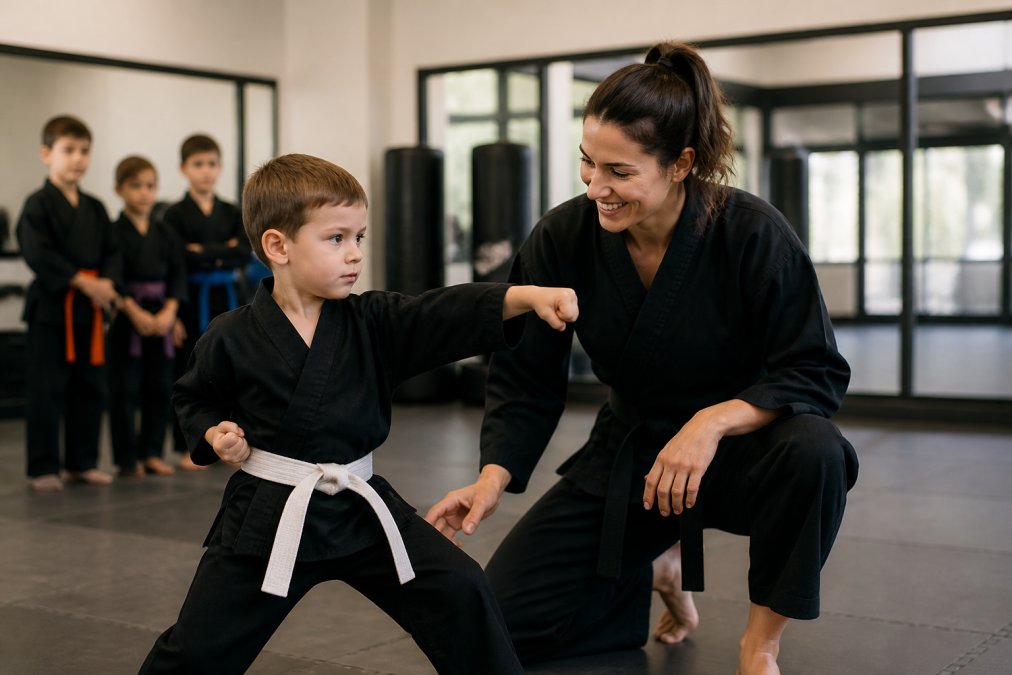
Here's what a well-run beginner class usually includes:
- A warm-up with light cardio and stretching to build flexibility and motor skills
- Stance and movement drills taught in small, repeatable steps
- A focus or concentration exercise, often a short game
- Partner work with controlled contact, if any
- A cool-down and a moment of reflection or goal-setting
What the First Month Actually Looks Like
Most schools won't show you this, so here is the honest arc for a child with no experience:
- Week 1, Orientation. Your child learns the room, the rules, and one or two basic movements. Expect some shyness and a lot of watching. The win this week is simply showing up twice.
- Week 2, The awkward stretch. This is when most kids say "I don't want to go." Movements feel clumsy, other students look smoother, and the novelty has worn off. Instructors who expect this and pair beginners with patient peers get kids through it.
- Week 3, Small clicks. A stance holds. A combination lands in the right order. Your child starts correcting themselves without being told, which is the first real sign of learning.
- Week 4, Ownership. Your child can follow the class routine without hand-holding and usually has a favorite drill. This is the point where parents start noticing carryover at home, like better focus on homework or more willingness to try hard things.
That four-week arc is why a 4-week trial tells you more than a 1-week one. One week shows you the room. Four weeks shows you whether your child settles in and stays engaged.
How Class Looks Different by Age
Ages 4 to 7 need shorter blocks, more games, and frequent praise (the CDC). Ages 8 to 11 can handle longer drills, start learning forms, and begin working toward belt progression. Ages 12 to 16 often want a mix of fitness and practical self-defense, and they respond better when they're treated as capable rather than cute.
A program that runs one format for every age will lose at least one of those groups. Ask how classes are split before you enroll.
What to Watch For as a Parent
Sit in on a class and watch three things: whether the instructor uses more encouragement than correction, whether every child gets individual attention at least once, and whether your child leaves smiling or dragging. Those signals beat any brochure.
Martial Arts Trial Programs: 1-Week vs 4-Week Options
Martial arts trial programs let families test a school before committing, and they come in two common formats: a 1-week trial and a 4-week trial. The shorter option suits families who want a quick feel for the environment. The longer one gives a child enough time to settle in and gives parents real evidence of whether it's working.
Trial Type | Duration | Best For | What It Reveals |
|---|---|---|---|
1-Week Trial | About 5 days | Families testing schedule fit | Class format, instructor style, first impressions |
4-Week Trial | About one month | Families judging real progress | Whether your child settles in and stays engaged |
A 1-week trial answers surface questions: Is the location workable? Do the instructors connect with kids? Does my child leave smiling or dragging?
A 4-week trial answers the deeper question: will this stick? Four weeks is enough for a child to move past the awkward beginner phase and for parents to see changes in focus or confidence at home.
Great Way Martial Arts offers both a 1-week and a 4-week trial so families can choose based on how much certainty they need before enrolling.
Comparing What Local Programs Offer
Most martial arts school pages are promotional, which makes them nearly useless for comparison. This section gives you a neutral framework. Use the same criteria for every school you visit, write down the answers, and compare them side by side. The school that markets best is rarely the school that fits your child best.
The Five Criteria That Actually Matter
- Teaching method. Does the instructor adapt to how your child learns, or expect every student to copy a demonstration? Children absorb technique visually, verbally, and physically, and a program that only teaches one way will lose the kids who need another.
- Skill progression. Ask to see the progression path. A strong program defines what a student can do at each level, not just what belt they wear. If a school can't explain what separates a beginner from an intermediate student beyond belt color, that's a warning sign.
- Instructor stability. Ask how long instructors stay and whether they teach as their primary work. A child who bonds with an instructor and then loses them often disengages entirely, and high turnover means your child restarts relationships every few months.
- Safety practices. Ask about instructor-to-student ratios, how contact is introduced, and whether structured warm-ups happen every class. Programs that skip warm-ups or let beginners spar early put kids at avoidable risk.
- Fit for your child's temperament. A competition-free environment suits kids who shut down under pressure. A structured, predictable room often works better for neurodivergent children than a high-energy, chaotic one. Ask how the school handles sensory needs and whether instructors are trained to adapt.
How to Run the Comparison
Visit at least two schools and watch a full class at each. Bring the five criteria above and score each school on a simple scale, then ask your child how each class felt. A child who wants to go back is the strongest signal you'll get, and it's worth more than any checklist.
Skill Progression: What to Look For
A mapped progression path tells you what your child is working toward and roughly how long each stage takes. Look for programs that blend multiple styles, since exposure to different techniques keeps students engaged longer than a single rigid format. Ask whether progress is celebrated in small steps, because kids who see frequent wins stay in the sport longer than kids waiting months for a single belt test.
Safety and Injury Prevention
Safety in youth martial arts comes down to instructor supervision, controlled contact, and proper warm-ups. Ask whether contact is introduced gradually and whether sparring is optional. A competition-free environment removes one major injury source, since students aren't training at full intensity for tournaments.
For parents of children with neurodivergent needs, a structured, predictable environment with clear routines often works better than a high-energy, chaotic one. Ask how the school handles sensory needs and whether instructors are trained to adapt.
Questions to Ask Before You Enroll
Before you enroll, ask these questions directly. The answers will tell you more than any tour.
- How long do your instructors stay? Look for full-time, career instructors rather than rotating part-time staff.
- Can my child try before committing? Ask about 1-week and 4-week trial options.
- Do you register year-round? Year-round registration means you don't wait months for the next intake.
- How do you handle different learning styles? A program should adapt to visual, auditory, and kinesthetic learners.
- What does a beginner's first month look like? You want a clear answer, not a vague one.
- Is there a competition requirement? If your child isn't competitive, a no-tournament environment removes pressure.
- How do you keep kids engaged? Ask about games, goal-setting, and how progress is celebrated.
- What happens if my child wants to stop? Understand the commitment and any notice terms before signing.
Conclusion
Finding the right martial arts alternative for your child is less about the school's name and more about whether the environment fits how your kid learns and grows. The right program builds confidence, discipline, and fitness without the pressure that pushed your child away from the last one.
At Great Way Martial Arts, we've taught Kelowna families since 1993 with full-time career instructors, a systematized goal-setting system, and a competition-free approach that blends more than 10 styles. Our teaching adapts to visual, auditory, and kinesthetic learners, and our 1-week and 4-week trials let you see the fit before you commit. Registration runs year-round. Get started with Great Way Martial Arts and give your child a program built around confidence, not competition.
Frequently Asked Questions
What should parents look for in a beginner-friendly martial arts school?
Look for a program with beginner classes designed for no experience, instructors who adapt to different learning styles, and a supportive environment without competition pressure. Ask about trial periods so your child can test the fit before committing. Check whether registration is year-round, which means your child can start when they are ready rather than waiting for a new session.
Do martial arts schools offer trial periods for new students?
Many do, and trial length varies. Some offer a 1-week trial, while others provide a 4-week option that gives your child enough time to settle into the routine and for you to see how instructors work with beginners. A longer trial is useful if your child has quit a previous program and you want to confirm the new one holds their interest.
How do I know if a martial arts program is the right fit for my child?
Watch a class before enrolling. Notice whether instructors use different teaching methods for visual, auditory, and kinesthetic learners. Ask how they handle a child who gets frustrated or distracted. If your child has tried martial arts before and quit, ask what the program does differently. A trial period lets you observe your child's actual response rather than guessing.
Are there martial arts programs that focus on confidence rather than competition?
Yes. Some schools build their curriculum around personal growth, goal-setting, and character development instead of tournaments and travel. These programs suit children who want fitness and discipline without competitive pressure. Ask directly whether the school requires tournament participation or if it is optional, and whether belt progression depends on competition results.