Martial Arts Curriculum for Teens: The 2026 Guide
Table of Contents
- Why a Purpose-Built Martial Arts Curriculum for Teens Matters
- The Benefits of Martial Arts for Teenagers
- Core Components of a Well-Rounded Teen Curriculum
- Martial Arts for ADHD and Focus: What Parents Should Know
- How to Choose a Martial Arts School for Teens
- Adapting Your Curriculum for Neurodivergent Teens
- Conclusion
- Frequently Asked Questions
Last Updated: September 14, 2026
Why a Purpose-Built Martial Arts Curriculum for Teens Matters
A martial arts curriculum for teens is a structured training plan built for adolescent bodies, attention spans, and social needs. It differs from adult programs in pace, feedback style, and emotional support. Most schools push teenagers into adult classes, and that shortcut is why so many quit within months.
This guide from Great Way Martial Arts draws on its experience teaching adolescents in a competition-free setting. Below: what a strong teen curriculum contains, how belt progression should work, and how to judge whether a school fits your teenager.
The Difference Between Teen Programs and Adult Classes
Adult classes assume a student chose to be there. Teens often arrive because a parent signed them up, which changes everything about motivation.
A dedicated teen program accounts for that. Instructors expect shorter attention windows, more social anxiety, and growth spurts that affect coordination. They correct gently, celebrate small wins loudly, and build in peer encouragement rather than pure individual drill.
Teen classes therefore rotate activities more often: a typical session moves through warm-up, technique work, partner drills, and a short conditioning block, each lasting ten to fifteen minutes (the WHO). Adult classes can hold one drill for thirty minutes. Teens cannot.
The Benefits of Martial Arts for Teenagers
The benefits of martial arts for teenagers extend well past fitness: coordination, emotional regulation, and a durable sense of self-respect. Many parents notice changes at home before they notice changes in the training hall.
Physical Conditioning and Motor Skills
Adolescent bodies are changing fast, and martial arts gives that change a productive outlet. Training develops balance, flexibility, and core strength at the age when many teens become sedentary. Motor skills sharpen through repetition: footwork, striking mechanics, and grappling positions all demand coordination that transfers to other sports.
Confidence, Respect, and Character Development
Confidence in teenagers rarely comes from praise. It comes from earned competence. When a fifteen-year-old finally lands a clean technique after weeks of practice, that moment does something a trophy never can.
Respect works the same way. Students bow to partners, wait their turn, and learn that control matters more than force. Character development is not a slogan; it is the daily habit of showing up, listening, and trying again.
Core Components of a Well-Rounded Teen Curriculum
A complete teen curriculum balances three pillars: striking, grappling, and self-defense. Schools that teach only one leave gaps that show up later, especially in a real confrontation.
Striking, Grappling, and Self-Defense
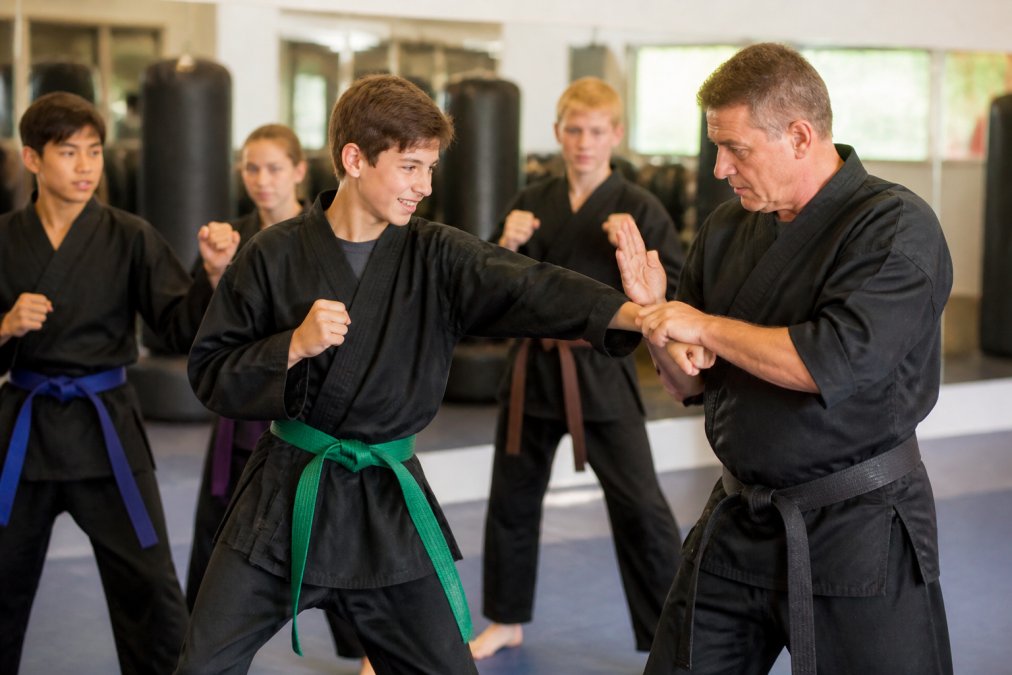
Striking covers punches, kicks, knees, and elbows; styles like taekwondo and kickboxing lean heavily here, developing timing and distance management. Grappling, drawn from Brazilian jiu-jitsu and wrestling, teaches control on the ground, where most real altercations end up. Self-defense ties both together with scenario drills: what to do if grabbed, cornered, or pressured.
A balanced curriculum rotates between all three across the week. Teens learn that sparring is controlled, supervised, and optional in most beginner-friendly programs, not a weekly fight night.
Belt Progression and Goal-Setting
Belt progression gives adolescents something rare: a visible, earned measure of progress. Each rank should carry specific technical requirements, so students know exactly what "ready" means. This turns vague ambition into a checklist.
That structure is why goal-setting works so well in martial arts. A teen who can see the next belt, technique, and test learns to break big goals into small steps, a skill that carries into schoolwork and, eventually, employment.
A well-built teen ranking system follows a predictable shape. Most schools use a colored-belt ladder with a fixed number of ranks between white and black, commonly eight to twelve, and each rank has a written syllabus of techniques, forms, and drills the student must demonstrate. Testing is typically scheduled every two to four months, not on demand, so students learn to prepare on a timeline rather than cram.
| Stage | Focus | Typical Timeframe | What Success Looks Like |
|---|---|---|---|
| Beginner | Basic stances, strikes, safety | First 3-6 months | Comfortable in class, knows the routine |
| Intermediate | Combinations, partner drills, first forms | 6-18 months | Sparring control, first belt milestones |
| Advanced | Full sparring, grappling, leadership | 18+ months | Assists newer students, tests for senior ranks |
Three design choices separate a strong ranking system from a weak one:
- Published requirements. The syllabus is written down and available to students and parents, not kept secret. Teens respond to transparency.
- Skill-based promotion. Rank reflects demonstrated competence, not attendance alone. A student who shows up for two years but cannot perform the material should not advance.
- Age-appropriate pacing. Teens should not be rushed to black belt to satisfy a marketing promise. A realistic teen-to-black-belt timeline is often four to six years of consistent training, and schools that advertise faster should be asked exactly what is being compressed (pubmed.ncbi.nlm.nih.gov).
Mental Health, Anxiety, and Academic Stress
Most curriculum guides stop at fitness and discipline. The teen years are also when anxiety, social pressure, and academic stress peak, and a well-designed program can address them directly (Overview: Mental health of youth and young adults).
The mechanism is straightforward. A predictable routine lowers anticipatory anxiety. Controlled exertion burns off stress hormones. Partner drills require eye contact and cooperation in a low-stakes setting, a gentle exposure exercise for socially anxious teens. And the rank system gives a teen one domain where effort visibly produces results, a counterweight when school feels out of control.
For many families, the training hall becomes the most consistent structured hour in a teenager's week. That is not a clinical claim, and martial arts is not a substitute for professional mental health care. But for many families, the training hall becomes the most consistent structured hour in a teenager's week. Establishing this reliable rhythm often requires securing the proper essential training equipment to ensure that every student remains prepared for the physical demands of their practice.
Transitioning From Teen to Adult Programs
Most guides stop at age sixteen or seventeen. The bridge to adult training is where retention is won or lost.
A deliberate handoff looks like this: the teen spends a few months in a hybrid slot, training with the teen group but joining adult classes for specific sessions, paired with an adult mentor for partner work. Intensity and contact rise gradually rather than all at once, so the transition feels like a promotion, not an abandonment.
Schools that skip this step lose older teens at exactly the moment they become capable of the most rewarding training of their lives.
Martial Arts for ADHD and Focus: What Parents Should Know
Martial arts for ADHD and focus works because the training itself is the intervention. Short activity blocks, clear instructions, and immediate physical feedback match how many ADHD brains learn. A teen who cannot sit through a forty-minute lecture often thrives in a forty-minute class.
Structure matters more than style. Look for instructors who give one instruction at a time, use visual demonstration alongside verbal explanation, and keep correction specific and calm. Random punishment or public criticism destroys the benefit entirely.
Parents often ask how quickly they will see change. That timeline is general, not guaranteed, and depends on consistency. That timeline is general, not guaranteed, and depends on consistency.
How to Choose a Martial Arts School for Teens
Knowing how to choose a martial arts school for teens comes down to five questions you can ask on a first visit. The answers tell you more than any brochure.
- Who teaches the teen class? Career instructors who teach full-time bring consistency. Rotating volunteers rarely do.
- Is it competition-focused? Some teens thrive on tournaments. Many do not, and a school that treats competition as mandatory will lose the quieter students.
- How is progress tracked? A systematized goal-setting system beats vague encouragement.
- Can they adapt to different learners? Visual, auditory, and kinesthetic learners need different cues. Ask how instructors handle that.
- Do students stay? Long-tenured instructors mean your teen bonds with someone who will still be there next year.
Watch a class before committing. Look at whether students seem relaxed or tense, whether instructors correct with patience or frustration, and whether teenagers actually appear to enjoy being there.
A Parent's Evaluation Framework
Most guides hand you a checklist. A framework is more useful, because it tells you what to weigh when two schools both look good on paper.
Score each school on four dimensions, one to five:
- Instructor stability. How long has the teen instructor been teaching? Has the school had the same lead instructor for three or more years? Turnover is the single strongest predictor of whether your teen will still be training in twelve months.
- Curriculum transparency. Can they show you a written syllabus, a testing schedule, and a clear path from beginner to advanced? Vague answers here usually mean vague progress.
- Class composition. Are there other teens the same age as yours? A class of eight-year-olds and one fifteen-year-old is not a teen program, regardless of what the schedule says.
- Communication with parents. Do they explain what your teen is working on and why? Schools that treat parents as partners produce better outcomes than schools that treat them as customers.
Red Flags Beyond Contracts
Long-term contracts before a trial class are the obvious warning sign. A few others matter just as much:
- Guaranteed black belts. Rank should be earned, not bundled into a package.
- Punishment-based discipline. Push-ups or public shaming as a response to a lost focus is a sign the instructor does not understand adolescent development.
- No trial period. A reputable school will let your teen try at least one class, often a week, before any payment.
- Pressure to buy gear on day one. Uniforms and equipment are reasonable purchases, but urgency tactics are not.
- No adult presence during teen classes. Parents should be welcome to observe. A school that discourages it is hiding something.
What to Ask on the First Visit
Bring these questions and listen for specifics, not slogans:
- What does a typical class look like from warm-up to cool-down?
- How do you handle a teen who is struggling with a technique?
- What happens if my teen wants to stop training for a few months?
- How do you communicate progress to parents?
- What is your policy on injuries and first aid?
A school that answers these clearly and without defensiveness is usually a school worth your teenager's time.
Home-Based Supplemental Training
One question almost no guide addresses: what should your teen practice between classes? A short, structured home routine accelerates progress and keeps momentum during busy school weeks.
A reasonable home curriculum for a beginner teen looks like ten to fifteen minutes, three times a week:
- Stance and footwork drills, moving through basic stances and stepping patterns in front of a mirror.
- Shadow striking, slow, controlled repetitions of the punches and kicks currently being taught, focusing on form over speed.
- Mobility work, hip openers, hamstring stretches, and shoulder mobility, which matter more during growth spurts.
- Notebook review, writing down the techniques covered in the last class and one thing to improve next time.
Ask the instructor for a home practice sheet. Schools that provide one usually track progress carefully, and practicing outside class separates teens who plateau from teens who keep advancing.
Adapting Your Curriculum for Neurodivergent Teens
Neurodivergent teens need structure, predictability, and sensory awareness, not a watered-down program. The techniques stay the same. The delivery changes.
Practical adaptations that work include:
- Consistent class routines so students know what comes next
- Advance warning before loud noises, partner changes, or sparring
- Extra processing time after instructions, without singling anyone out
- Quiet spaces available when overstimulation hits
- Small-group options for students who find large classes overwhelming
The goal is never to separate neurodivergent teens from the group, but to remove the barriers that would push them out. Many schools find these adjustments help every student, not just the ones who need them most.
Conclusion
Finding the right martial arts curriculum for teens is a question of fit: the right pace, instructors, and environment for your specific teenager. Great Way Martial Arts has taught teens in a supportive, competition-free setting since 1993, using career instructors, a systematized goal-setting system, and training that adapts to visual, auditory, and kinesthetic learners. Our Teen Martial Arts (Ages 12-16) program builds self-control, focus, and physical fitness without tournament pressure, and for younger siblings not yet in their teens, there are dedicated programs like Kung Fu Cubs (Ages 4-5) | Dragons (Ages 6-7) and Champions Kung Fu (Ages 8-11). Get started with Great Way Martial Arts and give your teen a place to grow.
Frequently Asked Questions
Which martial art is best for teens?
There is no single best style. A strong martial arts curriculum for teens blends striking, grappling, and self-defense so students develop well-rounded skills. Taekwondo and karate build kicks and focus, Brazilian jiu-jitsu and Wing Chun teach close-range control, and kickboxing improves fitness. The right fit depends on your teen's goals, learning style, and whether they prefer a competition-free environment. Visit a class and watch how instructors adapt to different learners before deciding.
How does martial arts training improve focus and discipline in teens?
Teen martial arts training uses repetition, structured drills, and clear belt progression to build focus. Students learn to follow multi-step instructions, control their reactions during sparring, and set short-term goals they can measure. Programs that include mindset training and goal-setting systems help teens carry those habits into school and home. The discipline comes from consistent practice, not punishment, which is why a supportive, competition-free environment often works better for adolescents.
What should a well-rounded teen martial arts curriculum include?
A complete martial arts curriculum for teens covers striking, grappling, and practical self-defense, plus physical conditioning and character development. Look for belt progression that rewards effort, safety protocols for sparring, and instruction that adapts to visual, auditory, and kinesthetic learners. Programs that add leadership training, goal-setting, and mindset work help teens build skills that transfer beyond the training hall.
Is 13 too old to start martial arts?
No. Teens who start at 13 or later often progress quickly because they can understand technique, follow instructions, and set their own goals. Beginner-friendly teen programs group new students together so no one feels behind. The key is finding a school with a dedicated teen curriculum rather than dropping older beginners into adult classes or young kids' groups.
How do competition-free environments benefit teen development?
Competition-free programs remove the pressure of tournaments and travel, which helps teens focus on personal growth instead of winning. This approach supports adolescents who feel anxious about performing in front of crowds or who have quit other activities because they felt too rigid. Belt progression and skill milestones still provide structure and motivation, but students measure success against their own progress.
How can a martial arts curriculum support teens with ADHD?
Teen martial arts for ADHD works best when instruction is short, structured, and multi-sensory. Breaking techniques into small steps, using visual demonstrations alongside verbal cues, and building in frequent movement helps teens stay engaged. Consistent routines and clear expectations reduce anxiety. Many parents find that the focus and self-control practiced in class carry over to schoolwork and daily routines at home.