Martial Arts for Shy Children: A Parent's Guide
Table of Contents
- Why Martial Arts Works for Shy Children
- How to Prepare a Child for Their First Martial Arts Class
- Martial Arts for Anxious Kids: Creating a Safe Learning Environment
- Confidence-Building Activities for Shy Children in Class
- Choosing the Right Martial Arts Program for Your Child
- Martial Arts for Kids in Kelowna: What to Look For
- Supporting Your Child Beyond the Studio
- Frequently Asked Questions
Last Updated: October 7, 2026
Why Martial Arts Works for Shy Children
Martial arts for shy children offers something many activities don't: a structured path to confidence without the pressure of competition. At Great Way Martial Arts in Kelowna, we work with children through a systematic approach to skill-building and self-belief.
The reason martial arts works so well for shy children comes down to three things. First, progress is measurable and personal. A child earns belts based on their own effort, not how they compare to classmates. Second, the physical activity itself reduces anxiety. Movement releases tension that shy kids often carry silently. Third, martial arts teaches a language for self-expression that doesn't require words at first, just body awareness and control.
Many shy children struggle in team sports where social performance matters as much as athletic skill. Martial arts is different. A student can be completely quiet and still succeed. The instructor sees effort, focus, and improvement. That's what gets recognized and rewarded.
What most parents miss is that martial arts isn't about fighting. It's about building a relationship with yourself, learning what your body can do, discovering your limits, and pushing past them safely. For a shy child, that internal victory is often the first real confidence boost they experience.
How to Prepare a Child for Their First Martial Arts Class
Preparation makes the difference between a child who walks in nervous and one who walks in ready. Here's how to set your child up for success.
Visit the studio in advance
Before the first class, visit the studio together. Let your child see the space, meet the instructor, and ask questions. A familiar environment feels less threatening than walking into something completely new.
During the visit, point out specific details. Show where students line up. Explain what the mats feel like. Let your child see other kids training. This removes the unknown factor that feeds anxiety.
Ask the instructor to show your child a basic stance or movement. Keep it short and playful. The goal isn't to teach anything, it's to show that the instructor is approachable and kind.
Talk about what to expect
Shy children need a clear picture of what will happen. Don't assume they understand. Walk through the class step by step.
Explain the routine:
- Students arrive and sit on the mat
- The instructor leads warm-ups and stretches
- Everyone practices the same movements together
- The instructor gives individual feedback
- Class ends with a cool-down
Use simple language. "The instructor will show you how to make a fist. Then everyone practices together. No one is watching you specifically. Everyone is learning."
Address specific worries. If your child fears making mistakes, explain that mistakes are how learning happens. If they worry about being watched, remind them everyone is focused on their own movements.
Set realistic goals together
Work with your child to pick one small goal for the first month. Not "become confident" or "get a belt." Something specific and achievable.
Good goals:
- Learn one new kick
- Attend class without feeling scared
- Try the warm-up stretches
- Ask the instructor one question
Write the goal down. Check in after each class. Celebrate progress, not perfection. A shy child who attends four classes has already succeeded.
Martial Arts for Anxious Kids: Creating a Safe Learning Environment
Anxious children need an environment that feels safe before they can focus on learning. The right studio makes all the difference.
A safe environment means several things. The instructor notices when a child is overwhelmed and gives space without judgment. Classes aren't crowded or chaotic. The studio doesn't emphasize competition or tournaments. Everyone moves at their own pace.
At Great Way Martial Arts, we use a systematized goal-setting approach that lets each student progress independently. An anxious child isn't compared to faster learners. They're measured against their own baseline. That shift alone reduces anxiety significantly.
The physical space matters too. Calm music during class keeps energy focused, not frantic. Instructors who speak in measured tones rather than shouting create a peaceful atmosphere.
Look for studios that explicitly welcome anxious and shy children. Ask the instructor directly: "How do you work with kids who get nervous?" Their answer tells you everything. A good instructor will describe specific strategies, breaking movements into smaller steps, offering encouragement without pressure, allowing kids to observe before participating.
Confidence-Building Activities for Shy Children in Class
Confidence grows through small wins. The best martial arts classes for shy children build these wins into every session.
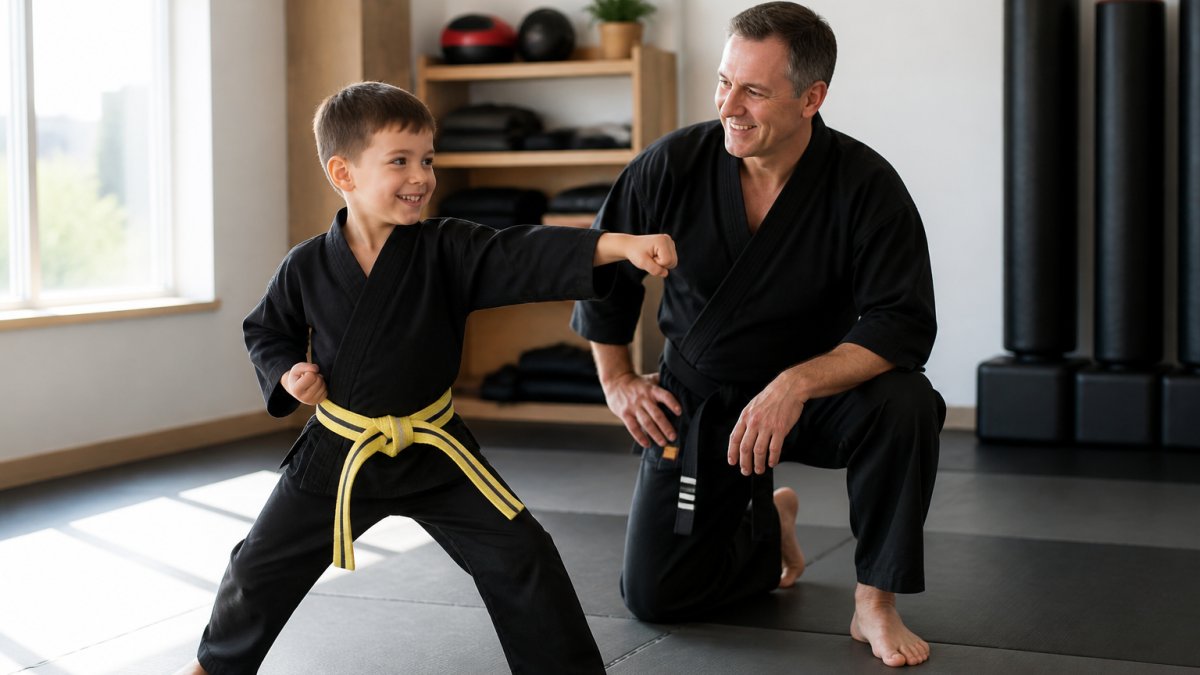
Effective confidence-building activities share a pattern. They're achievable. They're recognized. They're repeated. Here's what works:
Mastery of basics. Before learning complex moves, a shy child spends time perfecting a simple stance or punch. Mastery builds confidence faster than variety. Once they own one movement, they're ready to build on it.
Peer observation. Shy children often learn better by watching than by being watched. Good instructors let anxious kids observe for a few minutes before jumping in. This reduces pressure and lets them understand the movement first.
Individual recognition. The instructor notices effort, not just results. "You focused really hard on that kick" matters more than "You did it perfectly." Shy children respond to specific, honest feedback.
Progressive challenges. Each week introduces one new element. Not five new things. One. The child masters it, feels proud, and is ready for the next step.
Quiet achievement. Some kids don't want applause or attention. Good instructors recognize this. A quiet nod, a belt advancement, or a private word works better than public praise for a shy child.
Choosing the Right Martial Arts Program for Your Child
Not all martial arts programs work the same way. For a shy child, the program design matters more than the style.
Look for non-competitive environments
Competitions trigger anxiety in shy children. The pressure to perform in front of judges and crowds contradicts everything you're trying to build. Choose a program that doesn't require tournaments or competitions.
Many excellent martial arts schools focus entirely on personal development. Belt advancement is based on skill mastery and effort, not tournament wins. This removes a major source of stress.
Ask directly: "Do you require students to compete?" If the answer is yes, ask if it's optional. If it's mandatory, keep looking.
Check instructor experience with shy and anxious children
Not all instructors are trained to work with anxious kids. Some don't understand the difference between pushing a child and pressuring them.
Ask these questions:
- How many shy or anxious children do you teach?
- What strategies do you use when a child gets nervous?
- How do you give feedback without making kids feel judged?
- Do you adapt teaching methods for different learning styles?
Listen for specifics. An instructor who says "I'm very patient" is less reliable than one who says "I break complex movements into three smaller steps and practice each one separately until the student feels confident."
Verify adaptive teaching methods
Children learn differently. Some are visual. Some learn by listening. Some need to move and feel their way through a technique. The best programs adapt to these differences.
Ask if the instructor uses multiple teaching methods:
- Showing the movement (visual)
- Explaining it step by step (auditory)
- Letting students practice and feel it (kinesthetic)
Great Way Martial Arts teaches to all three learning styles. This matters because a shy child who struggles with one approach won't feel broken, they'll simply learn in a different way.
Martial Arts for Kids in Kelowna: What to Look For
Finding the right program in Kelowna means looking for specific qualities that support shy children.
A good program has been around long enough to build real community. Instructors who've taught in Kelowna understand local families and what works here. That experience matters.
Look for programs that emphasize character development alongside physical skills. Discipline, kindness, and self-control should be named explicitly. If the studio only talks about kicks and punches, keep looking.
Check whether the program works with local organizations that support child development. Partnerships with groups focused on youth wellness signal that the studio takes child well-being seriously.
Finally, visit during an actual class. Watch how the instructor interacts with quiet students. Do they seem comfortable? Are they participating at their own pace? Does the instructor check in with them? These observations tell you more than any description.
Supporting Your Child Beyond the Studio
Martial arts training doesn't end when class does. What happens at home matters just as much.
Reinforce effort, not outcomes. After class, ask "What did you work on today?" not "Did you do it right?" This shifts focus from performance to process.
Practice at home if your child wants to. A few minutes of stretching or basic movements builds muscle memory and confidence. Make it optional and fun, never forced.
Connect martial arts lessons to real life. When your child shows courage at school, link it to martial arts: "That took the same kind of bravery you showed in class." This helps them see martial arts as training for life, not just a weekly activity.
Be patient with progress. Shy children often show confidence gains at home before they show them in class. A child who speaks up at dinner might still be quiet at martial arts. Both are victories.
Celebrate consistency. Attending class regularly, even when nervous, is the real win. Belt advancement and new skills follow naturally from showing up.
Building confidence in a shy child takes time and the right environment. Martial arts for shy children works because it's personal, structured, and pressure-free. When you find a program that understands this, one where instructors adapt to your child's learning style and progress is measured individually, transformation happens quietly and naturally.
Great Way Martial Arts has been teaching children in Kelowna since 1993, building confidence through a systematized approach that works for every learning style. Our instructors focus on character development, self-control, and kindness alongside physical skills. We don't compete or travel, we build depth in your child's own growth. We offer Kung Fu Cubs (Ages 4-5) | Dragons (Ages 6-7), Champions Kung Fu (Ages 8-11), and Teen Martial Arts (Ages 12-16) programs designed to meet each child where they are. If your shy child is ready to discover what they're capable of, get started with Great Way Martial Arts and watch them grow from the inside out.
Frequently Asked Questions
Can martial arts help a shy child build confidence?
Yes. Martial arts for shy children creates a structured, non-judgmental space where they practice skills at their own pace. As they master techniques and achieve small goals, they experience real progress that translates to increased self-assurance both in class and at home. The focus on personal improvement rather than competition removes pressure and allows shy children to celebrate their own wins.
How do I prepare a child for their first martial arts class if they're nervous?
Visit the studio beforehand so your child can see the space and meet the instructor in a relaxed setting. Talk through what a typical class looks like, explain that everyone starts as a beginner, and emphasize that the instructor's job is to help them feel comfortable. Arrive early on day one so there's no rush.
What should I look for in a martial arts program for an anxious child?
Seek programs that emphasize personal growth over competition, have instructors trained in working with anxious or neurodivergent children, and use multiple teaching methods (visual, auditory, and kinesthetic). Ask whether the school adapts instruction to individual learning styles and whether parents can observe classes. A supportive community and clear, achievable goal-setting systems also help anxious children feel safe and motivated.
Are there martial arts classes for kids in Kelowna that focus on confidence building?
Yes. Great Way Martial Arts has served the community since 1993 with programs specifically designed for children's personal development. Their approach eliminates competitions and tournaments, incorporates mindset training and goal-setting systems, and uses instructors trained to work with different learning styles. They offer age-specific programs like Kung Fu Cubs for younger children and Champions Kung Fu for older kids, all in a supportive, non-competitive environment.