Martial Arts vs Competitive Sports: Which Fits Your Child?
Table of Contents
- Martial Arts vs Competitive Sports: Key Differences at a Glance
- Training, Philosophy, and Outcomes: A Side-by-Side Comparison
- The Benefits of Martial Arts for Kids: Confidence, Focus, and Self-Control
- Where Competitive Sports Win: Teamwork, Cardio, and Game Day Thrills
- Martial Arts Classes for Beginners: What the First Few Months Look Like
- Choosing the Right Martial Arts School in Kelowna
- Conclusion: Matching the Activity to Your Child's Needs
- Frequently Asked Questions
Last Updated: October 3, 2026
Martial Arts vs Competitive Sports: Key Differences at a Glance
The martial arts vs competitive sports decision comes down to one question: does your child thrive on winning, or on improving? Competitive sports measure a child against other children. Martial arts measure a child against their own last attempt. That single difference shapes everything that follows, from how practice feels to what your kid takes away from it.
At Great Way Martial Arts, we have taught in Kelowna since 1993, and we have watched hundreds of families wrestle with this exact choice. Below, we break down training styles, philosophy, and outcomes so you can match the activity to your child rather than to a trend.
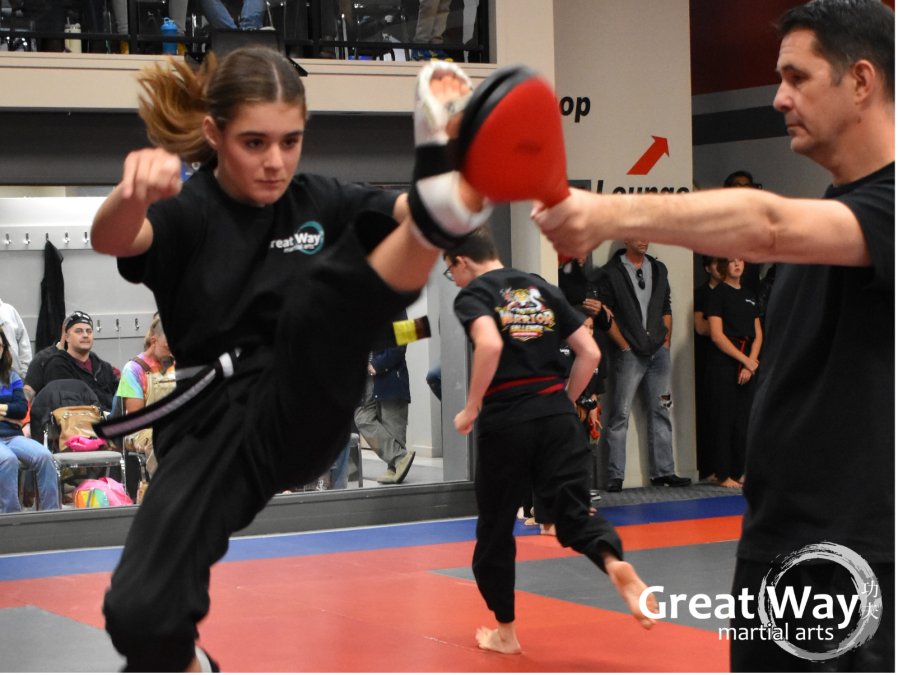
A focused teenage girl in a Great Way Martial Arts uniform performing a jump kick inside a bright, welcoming dojo, with an assistant holding a kick paddle; in the background, parents watch the students
How the Two Structures Compare
Martial arts is an individual practice built around personal progression, where students advance through a structured curriculum at their own pace. Competitive sports is a team or head-to-head activity organized around leagues, standings, and games against opponents.
The practical differences show up fast:
Factor | Martial Arts | Competitive Sports |
|---|---|---|
Progress measured by | Personal milestones and skill tests | Wins, standings, playing time |
Team structure | Individual within a group | Interdependent team |
Travel required | Minimal to none | Regular away games |
Season length | Year-round | Seasonal |
Pressure source | Self and instructor | Scoreboard and spectators |
Best for | Kids who need confidence and focus | Kids who need teamwork and competition |
Neither column is better. They simply suit different kids, and many children benefit from both at different stages.
Training, Philosophy, and Outcomes: A Side-by-Side Comparison
Training in martial arts builds skill through repetition, goal-setting, and steady feedback. Training in competitive sports builds skill through drills, scrimmages, and game-day performance under pressure.
The philosophies diverge in what they reward. Sports reward the fastest, strongest, and most competitive kids on a given day. Martial arts reward consistency, patience, and self-control, qualities any child can develop with guidance. As documented in ParticipACTION's report card on physical activity for children and youth, regular structured physical activity supports both mental and physical development, and the type of activity matters less than whether a child sticks with it.
That last point is the one most parents miss. A child who quits after two months gains almost nothing. A child who stays for two years gains fitness, discipline, and confidence that carries into school.
How Progress Is Measured
Progress in martial arts is measured through belt or level advancement, skill demonstrations, and instructor feedback. Progress in competitive sports is measured through statistics, rankings, and playing time.
For kids who find scoreboards stressful, the martial arts model removes a major source of anxiety. They still get clear feedback, just not public comparison. For kids who love the thrill of a scoreboard, sports deliver a motivation that a belt test cannot match.
The Benefits of Martial Arts for Kids: Confidence, Focus, and Self-Control
The benefits of martial arts for kids show up in confidence, focus, and self-control, and they tend to transfer to home and school. A child who learns to hold a stance while tired, or to reset after a mistake, is practicing emotional regulation in a structured setting.
At Great Way Martial Arts, our career instructors use a systematized goal-setting system alongside Brain Gym and Mindset Training. The aim is not just fitness but self-control, focus, and kindness. Our teaching method adapts to visual, auditory, and kinesthetic learners, which matters for kids who get frustrated when they are only told what to do rather than shown.
Parents often ask how this translates to behavior at home. The honest answer is that it builds gradually, through repetition and small wins. A child who earns a new level after weeks of practice learns that effort produces results, and that lesson sticks.
Where Competitive Sports Win: Teamwork, Cardio, and Game Day Thrills
Competitive sports win on teamwork, cardiovascular conditioning, and the shared energy of game day. Team sports teach kids to rely on each other, to handle a loss as a group, and to celebrate a teammate's success.
The cardio benefits are real too. Sports like soccer, hockey, and basketball involve sustained running and interval bursts that build endurance quickly. Game day also gives kids a taste of performing under pressure, which some children find genuinely motivating.
The trade-offs are worth naming. Team sports come with tryouts, playing time politics, and travel schedules that can consume entire weekends. A child who sits on the bench for most of a season may lose confidence rather than build it. For families in Kelowna balancing work and multiple kids, the logistics alone can decide the question.
Martial Arts Classes for Beginners: What the First Few Months Look Like
Martial arts classes for beginners focus on fundamentals, basic stances, and simple techniques, with no sparring or competition pressure in the early weeks. The first month is about showing up, learning the routine, and getting comfortable with the instructor and the group.
Here is what a typical first three months looks like:
- Weeks 1-2: Introduction to stances, basic strikes, and class etiquette. Your child learns names, rules, and warm-up routines.
- Weeks 3-6: Repetition of core movements, introduction to goal-setting, and the first small milestone.
- Weeks 7-12: Combinations, partner drills, and a first level or belt advancement. Confidence usually shows up here.
Choosing the right martial arts school matters more than the style. Look for instructors who stay long-term, a curriculum that adapts to different learning styles, and an environment where your child is not compared to anyone else. We keep a competition-free space for exactly this reason, and we are still open for registration across all programs.
Choosing the Right Martial Arts School in Kelowna
Choosing the right martial arts school in Kelowna starts with three checks: instructor stability, class structure, and whether the environment suits your child's temperament. A school is only as good as the people teaching in it week after week.
Here is a practical checklist we suggest to families, whether they train with us or elsewhere:
- Do the instructors teach full-time, or does turnover seem high?
- Is there a clear, structured curriculum with visible milestones?
- Can the school describe how it adapts to visual, auditory, and kinesthetic learners?
- Is there a trial or introductory period before any commitment?
- Do current parents speak positively about communication and safety?
- Is the schedule realistic for your family's week?
For families searching for martial arts near me in the Okanagan, visiting a class in person beats any online research. Watch how instructors speak to a child who is struggling. That moment tells you everything.
Conclusion: Matching the Activity to Your Child's Needs
The martial arts vs competitive sports choice is not about which activity is superior. It is about which one fits your child's temperament, your family's schedule, and the outcomes you care about most.
If your child needs confidence, focus, and a non-competitive environment, martial arts offers a structured path with clear milestones. Great Way Martial Arts has taught in Kelowna since 1993, with full-time career instructors, a systematized goal-setting system, and Brain Gym and Mindset Training built into every class. We are still open for registration for all programs. Get started with Great Way Martial Arts and give your child a place to grow at their own pace.
Frequently Asked Questions
What are the main differences between martial arts and competitive team sports?
Martial arts focus on individual progress, self-discipline, and personal goals, with no tournaments or travel required in programs like Great Way Martial Arts. Competitive team sports emphasize teamwork, game-day performance, and winning against opponents. In martial arts, students advance at their own pace through belt or skill milestones, while team sports measure success through league standings and scores. Both build fitness and confidence, but the structure and pressure points differ significantly.
Is martial arts considered a competitive sport?
Martial arts can be competitive if a school chooses to enter tournaments, but many programs, including Great Way Martial Arts in Kelowna, are deliberately competition-free. These schools focus on personal growth, self-control, and physical fitness rather than medals or rankings. For families seeking a non-competitive environment where kids build discipline without the stress of winning or losing, a competition-free martial arts program is a strong fit.
How does a non-competitive martial arts environment benefit children?
A non-competitive environment removes the fear of losing and lets children focus on their own improvement. At Great Way Martial Arts, kids work through a systematized goal-setting system that builds self-control, focus, and kindness. Without the pressure of tournaments or travel, children who might feel anxious in competitive settings can develop confidence at their own pace. This approach particularly suits kids who have quit rigid or highly competitive programs in the past.
What should parents look for when choosing a martial arts school in Kelowna?
Look for full-time, career instructors who stay long-term, a clear curriculum that blends multiple styles, and a teaching approach that adapts to visual, auditory, and kinesthetic learners. Ask whether the school is competition-free if your child prefers a low-pressure environment. Great Way Martial Arts has served Kelowna since 1993 and uses Brain Gym and Mindset Training to support focus and self-control. Visit the school, watch a class, and see if the atmosphere feels supportive.
How does Great Way Martial Arts' curriculum differ from traditional sports leagues?
Traditional sports leagues revolve around team schedules, playoffs, and travel. Great Way Martial Arts offers a competition-free curriculum blending over 10 styles, including Wing Chun and H.I.I.T. Kickboxing, with no tournaments or travel. The program integrates Brain Gym and Mindset Training to build self-control, focus, and goal-setting skills. Classes cater to different learning styles, making it a good fit for kids who thrive outside the typical team-sport structure.