Wing Chun Training for Adults: A 2026 Guide
Table of Contents
- What Is Wing Chun and Why Adults Choose It
- Core Wing Chun Principles and Centerline Theory
- Benefits of Wing Chun for Adults
- How Long to Learn Wing Chun
- Wing Chun Self-Defense Techniques and Pressure Testing
- How to Choose a Legitimate Wing Chun School
- Getting Started: What to Expect in Your First Class
- Frequently Asked Questions
Last Updated: September 23, 2026
What Is Wing Chun and Why Adults Choose It
Wing Chun is a Chinese martial art that emphasizes efficiency, economy of motion, and direct defense. Unlike many traditional martial arts that rely on strength or athleticism, wing chun training for adults focuses on technique, timing, and the principle of meeting force with minimal resistance. This makes it uniquely suited to adult learners who may not have trained as children or who seek a practical self-defense system without the competitive pressure of tournaments.
Adults are drawn to wing chun training for adults for several reasons. The art offers a structured path to self-defense competency in a reasonable timeframe. It builds functional strength and mobility without the joint stress of high-impact sports. Perhaps most importantly, it provides a community-based environment where progress is measured by personal improvement, not competition against others. At Great Way Martial Arts, we foster confidence, discipline, and strength in adults through a unique curriculum blending over 10 styles, including Wing Chun and H.I.I.T. Kickboxing. The non-competitive structure removes the intimidation factor that keeps many adults from starting martial arts later in life.
Core Wing Chun Principles and Centerline Theory
The foundation of wing chun rests on the centerline theory, which states that the most direct and efficient path between two points is a straight line. In combat, this means positioning your body and defenses along the vertical centerline that runs down the middle of your opponent's body. All wing chun techniques, strikes, blocks, and footwork, are organized around protecting and controlling this centerline.
This principle changes how adults approach self-defense. Rather than memorizing dozens of techniques for different scenarios, you learn to recognize the centerline and respond with economy of motion. A punch doesn't need to be powerful if it travels the shortest possible distance. A block doesn't need to be strong if it's positioned correctly. This efficiency is why smaller practitioners can neutralize larger opponents, technique replaces brute force.
The centerline theory also shapes training methodology. Every drill, every stance, every hand position teaches you to maintain centerline awareness. Over time, this becomes automatic. Your body learns the correct distance, angle, and timing without conscious thought. This is where muscle memory develops. The repetition builds neural pathways that allow you to respond instinctively under pressure.
Benefits of Wing Chun for Adults
Wing chun training for adults delivers physical and mental benefits that extend far beyond the training room. Physically, the art builds functional strength through isometric holds and dynamic resistance exercises. Your legs develop stability through stance training. Your core strengthens as you learn to generate power from your center rather than your arms. Joint mobility improves as you work through the full range of motion required by wing chun techniques.
The mental benefits are equally significant. Wing chun demands focus and presence. You cannot perform the drills effectively while thinking about work or personal stress. This meditative quality, the requirement to be fully present, is one reason adults report reduced stress after training. The mind-body connection strengthens as you learn to coordinate complex movements. Goal-setting becomes concrete and measurable. You track progress through mastery of specific techniques and drills rather than abstract fitness metrics.
Great Way Martial Arts emphasizes this holistic development through our systematized goal-setting system and mindset training, which helps students translate martial arts discipline into other areas of life.
How Long to Learn Wing Chun
The timeline for learning wing chun depends on your definition of "learning." Basic competency in foundational techniques typically takes 3-6 months of consistent training. Most adults train 2-3 times per week, which is sufficient to build muscle memory and understand core principles.
Intermediate proficiency, where you can apply techniques under mild pressure and string combinations together, usually requires 12-18 months. This is the point where wing chun begins to feel natural rather than mechanical. Your body has internalized the stance, the hand positions, and the timing.
Advanced proficiency, where you can spar effectively and adapt techniques to different opponents, typically requires 3-5 years of regular training. This timeline assumes consistent practice and quality instruction. Some adults reach this level faster if they train more frequently or have prior martial arts experience. Others progress more slowly, and that's perfectly acceptable, wing chun is not a race.
The key variable is consistency. Training three times per week for one year produces better results than training five times per week for three months. Your nervous system needs time to encode the patterns. Muscle memory develops through repetition over weeks and months, not hours of intense practice. This is why many adult learners prefer structured programs that emphasize steady progress over dramatic transformation.
Wing Chun Self-Defense Techniques and Pressure Testing
Foundational Techniques for Beginners
The first techniques you learn in wing chun training for adults are the foundational hand positions and defensive structures. The guard is your baseline defensive posture, hands positioned to protect your centerline while remaining ready to attack or defend. From the guard, you learn basic blocks that intercept incoming strikes along the centerline.
The siu nim tao form is the first form most students learn. It teaches the fundamental hand positions, weight distribution, and breathing patterns that underpin all other techniques. Practicing siu nim tao is like learning the alphabet before writing sentences. It's repetitive and sometimes feels slow, but it builds the foundation for everything that follows.
Striking techniques in wing chun emphasize directness and efficiency. The straight punch travels the shortest distance to the target. The palm strike can be used at close range where a full punch isn't possible. These strikes are practiced repeatedly until they become automatic. The goal is not power but precision and speed.
Sparring and Sticky Hands Drills
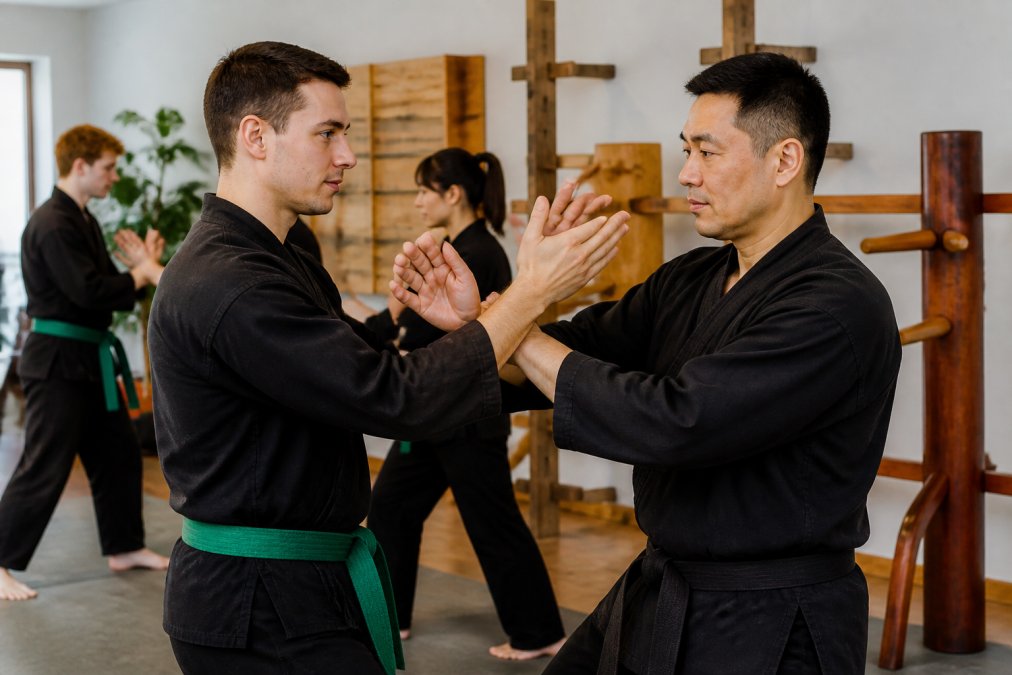
Sticky hands, or chi sao, is the signature training method of wing chun. Two practitioners maintain light contact with their forearms while moving and responding to each other's movements. The drill teaches you to feel your opponent's intentions through touch rather than relying on sight alone. This develops sensitivity and timing, critical components of effective self-defense.
Sticky hands begins slowly and stationary, then progresses to movement and increased speed. The drill is not competitive. Neither person is trying to "win." Instead, both are practicing how to maintain contact, sense incoming pressure, and respond with appropriate techniques. This is pressure testing in a controlled environment. You learn how techniques perform when an opponent is actively resisting, not just standing still.
Sparring in wing chun training for adults typically begins after several months of foundational training. The emphasis remains on technique and control rather than power. You practice distance management, timing, and decision-making under mild pressure.
How to Choose a Legitimate Wing Chun School
Not all wing chun instruction is equal. The quality of your training depends almost entirely on your instructor's knowledge, experience, and teaching ability. Here's how to evaluate a school before committing.
Getting Started: What to Expect in Your First Class
Your first wing chun class will likely feel awkward. You'll be learning new movements, new terminology, and new ways of thinking about body mechanics. This is completely normal. Every experienced martial artist started exactly where you are.
Frequently Asked Questions
Is wing chun training suitable for adults with no prior martial arts experience?
Yes, wing chun training for adults welcomes complete beginners. The discipline emphasizes foundational techniques and muscle memory development through structured drills rather than athletic ability. Most programs scale instruction to individual fitness levels, making it accessible whether you're returning to fitness after years away or starting fresh. Beginner-friendly classes focus on stance training, basic hand positions, and understanding centerline theory before progressing to more complex applications.
How long does it take to learn wing chun at a practical level?
Progress depends on training frequency and intensity. Most practitioners develop basic self-defense competency within 6-12 months of consistent training (2-3 sessions weekly). Foundational techniques and muscle memory build through repetition of drills and forms. However, wing chun is a lifelong discipline, deeper understanding of combat efficiency, pressure testing, and advanced techniques develops over years. Progress tracking systems help you recognize milestones, but realistic self-defense readiness typically requires sustained practice rather than quick mastery.
What are the main benefits of wing chun for adults beyond self-defense?
Wing chun training enhances physical conditioning, mobility, and mental focus through structured practice. The mind-body connection developed in training translates to improved self-control and stress relief. Many adults report better posture, increased confidence, and a sense of community within a supportive training environment. The discipline also builds self-discipline and patience as you progress through foundational techniques and drills. Unlike competitive martial arts, non-tournament training reduces pressure while maintaining the physical and psychological benefits of regular practice.
Can you self-teach wing chun, or do you need a qualified instructor?
While online resources exist, learning from a qualified instructor is strongly recommended. Wing chun relies on proper body mechanics, stance alignment, and pressure testing, details difficult to correct alone. An authentic instructor ensures you build correct muscle memory from the start, preventing compensatory movements that become harder to unlearn later. Instructors also provide pressure testing and feedback during sparring drills, essential for understanding how techniques work under resistance. Self-teaching risks developing poor habits that limit your progress and self-defense effectiveness.
How does wing chun differ from other martial arts for adults?
Wing chun emphasizes efficiency and directness rather than speed or strength, making it accessible across fitness levels. The focus on centerline theory and economy of motion means smaller individuals can be effective. Unlike some martial arts emphasizing tournaments or travel, many wing chun programs prioritize personal growth and defensive tactics in a non-competitive environment. The structured curriculum and systematized approach to goal-setting help adults see measurable progress. Integration with modern fitness methods also makes wing chun compatible with other training routines for those seeking variety.