5 Ways to Build Strength Without Heavy Gym Equipment
Last Updated: October 24, 2026
Quick Summary
You can build strength without heavy gym equipment by training five basic bodyweight patterns: push-ups, squats, lunges, planks, and table rows. Make each move harder over time by adding reps, slowing the lowering phase, or changing the angle, and train two to three full-body sessions a week.
- Start with three rounds of five basic moves, three days a week, taking about 20 minutes.
- Rest 60 seconds between rounds and chase clean form rather than speed.
- Pick one progression dial per week, such as adding reps or slowing the lowering phase to three seconds.
- A backpack loaded with books, a sturdy chair, and a filled water jug replace weights at home.
- Muscles need about 48 hours between hard sessions, so two full-body sessions a week is the minimum.
Table of Contents
- Why Bodyweight Training Builds Real Strength
- Method 1: A Beginner Strength Workout at Home You Can Start Today
- Method 2: Progressive Overload Without Weights
- Method 3: Turn Household Items Into Training Tools
- Method 4: Borrow Strength Patterns From Wing Chun
- Method 5: Build a Weekly Plan Around How Often to Strength Train at Home
- Start Your Strength Training With a Free Trial Class
- Frequently Asked Questions
Why Bodyweight Training Builds Real Strength
You do not need a rack of iron to get strong. Bodyweight training builds real strength because it loads your muscles through full ranges of motion while training balance, joint control, and core stability at the same time. At Great Way Martial Arts in Kelowna, BC, we have watched adults walk in convinced they need a gym membership to build strength, then surprise themselves within weeks using nothing but their own body weight to build strength.
The principle is simple. Muscle grows when it faces resistance it is not used to. Gravity supplies that resistance for free.
The Exercises That Carry the Most Load
Push-ups, squats, lunges, planks, and rows under a sturdy table cover every major muscle group. These five patterns push, pull, bend, and brace. Master them and you have a complete strength program with zero equipment.
The catch? Your body adapts fast. That is where the next four methods come in.
Method 1: A Beginner Strength Workout at Home You Can Start Today
Start with three rounds of five basic moves, three days a week. That is the whole beginner strength workout at home, and it takes about 20 minutes.
Here is the session:
- 10 push-ups, on your knees if needed
- 15 bodyweight squats
- 10 lunges per leg
- 20-second plank
- 10 table rows
Rest 60 seconds between rounds. Do not chase speed. Chase clean form.
Watch out: Most beginners skip the warm-up and dive straight into push-ups. Cold shoulders and wrists complain later. Two minutes of arm circles and slow squats prevents that.
If you are not athletic and worry this is too much, you are exactly who this is built for. A supportive beginner class environment makes the same moves feel manageable. Our guide on whether martial arts suits non-athletes covers how to start when fitness feels out of reach.
Method 2: Progressive Overload Without Weights
Progressive overload without weights means making each move harder as your body adapts, rather than adding plates. Strength comes from increasing demand, and demand has more dials than just weight.
Seven Ways to Make Any Move Harder
- Add reps, one or two at a time
- Slow the lowering phase to three seconds
- Pause at the hardest point for two seconds
- Reduce your base of support, like lifting one foot
- Change the angle, like elevating your feet for push-ups
- Add a hold at the end of the set
- Shorten your rest between rounds
Pick one dial per week. Changing everything at once makes it impossible to know what worked.
A common mistake is adding reps forever. Past a certain point, ten perfect push-ups beat thirty sloppy ones every time.
Method 3: Turn Household Items Into Training Tools
Your home is already a gym if you look at it differently. A backpack loaded with books becomes a weight for squats and rows. A sturdy chair handles triceps dips and step-ups. A filled water jug works for shoulder presses and carries. These improvised tools serve as a practical starting point while you gradually assemble a durable home gym that supports more consistent and varied training sessions.
Try this circuit twice a week:
- Backpack squats: 3 sets of 12
- Chair step-ups: 3 sets of 8 per leg
- Water jug shoulder press: 3 sets of 10
- Backpack rows: 3 sets of 12
Add books to the backpack as the sets get easy. That is progressive overload using items you already own.
Watch out: Test every chair and table for stability before you load it. A wobbly chair under a dip is how wrists get hurt.
Method 4: Borrow Strength Patterns From Wing Chun
Wing Chun offers some of the smartest bodyweight strength patterns in martial arts. The style trains you to generate force from the ground up, through relaxed structure rather than tense muscle.
Three patterns transfer directly to home training:
- The horse stance. Sink into a wide stance, knees bent, back straight. Hold for 30 seconds. This builds leg and hip endurance fast.
- The forward step. Step and settle your weight without bobbing. It trains single-leg control and balance.
- The punch with structure. Throw a slow punch while keeping your shoulders relaxed and your stance rooted. It teaches your whole body to work as one unit.
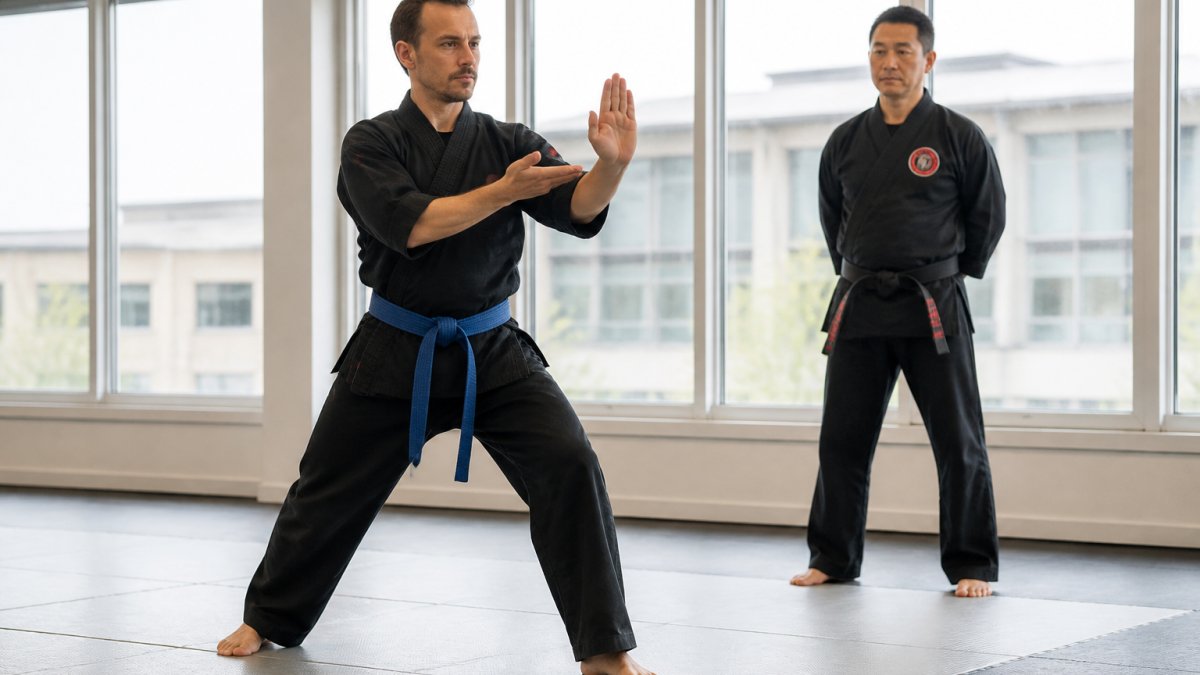
These patterns are also why so many adults find Wing Chun approachable. The movements are compact, low-impact, and beginner friendly. You can see the full Traditional Wing Chun For Adults program or read the deeper Wing Chun training guide for adults before your first class.
Method 5: Build a Weekly Plan Around How Often to Strength Train at Home
How often to strength train at home comes down to two full-body sessions a week at minimum, three if you recover well. Muscles need about 48 hours between hard sessions. More is not better; consistent is better.
A Sample Week for a Beginner
| Day | Session | Time |
|---|---|---|
| Monday | Full-body circuit, 3 rounds | 20 min |
| Tuesday | Walk and stretch | 20 min |
| Wednesday | Full-body circuit, 3 rounds | 20 min |
| Thursday | Rest or easy mobility | 10 min |
| Friday | Full-body circuit, 3 rounds | 20 min |
| Saturday | Wing Chun class or long walk | 45 min |
| Sunday | Rest | , |
Adjust the days to fit your life. A plan you follow beats a perfect plan you abandon.
Start Your Strength Training With a Free Trial Class
Building strength at home works. But structure, coaching, and a room full of people doing the same thing works faster, especially when motivation dips. That is the gap a class fills.
At Great Way Martial Arts, we have taught in Kelowna since 1993 with career instructors who stay long term. Our classes suit visual, auditory, and kinesthetic learners, so nobody gets left behind. Registration runs year round, and beginners are welcome at any point. If you want a faster-paced option to complement your home sessions, our H I I T | High Intensity Interval Training For Adults classes fit the bill.
If you are still deciding which class fits, our step-by-step beginner class guide walks you through choosing well.
Frequently Asked Questions
Can you build strength without heavy gym equipment?
Yes. Strength comes from how much load your muscles handle relative to what they can already do, not from the equipment itself. Bodyweight movements like push-ups, squats, lunges and planks load the same muscle groups as machines. When those get easy, you add difficulty by slowing the movement, changing the angle, or training on one leg instead of two. Wing Chun stance work and slow form practice add another layer by keeping muscles under tension for longer periods.
What are the best bodyweight exercises for strength at home?
Start with five patterns: a push (push-ups or incline push-ups), a squat (bodyweight or chair-assisted), a hinge (hip bridges or single-leg bridges), a pull (towel rows under a sturdy table or doorframe rows), and a hold (front plank). These cover the main muscle groups and need no equipment. Add slow Wing Chun stance holds to train the legs and posture at the same time. Two or three rounds of each is enough for a beginner strength workout at home.
How often should you do strength exercises at home?
Two to three sessions per week is a practical starting point for most beginners, with at least one rest day between sessions so muscles recover. Each session can run 20 to 30 minutes. Once that feels manageable for a few weeks, you can add a third or fourth day. Pairing home sessions with a structured class, such as Wing Chun or H.I.I.T., gives you variety and keeps the weekly load consistent.
Can martial arts movements help build strength and improve posture?
Yes. Wing Chun trains you to hold a rooted stance, keep the spine tall, and move slowly under tension, which strengthens the legs, core and upper back. Those are the same muscles that support good posture through a school day or a desk shift. At Great Way Martial Arts in Kelowna, classes blend stance work, form practice and partner drills, so strength and posture improve together rather than as separate goals.
Your body is the only equipment you cannot forget at home. The challenge is staying consistent long enough to see it work. That is where Great Way Martial Arts helps: full-time career instructors, a systematized goal-setting system, and a competition-free environment built for steady progress. Get started with Great Way Martial Arts and turn bodyweight basics into real, lasting strength.