Why Your Child Loses Focus During Sports and How to Help
Last Updated: October 31, 2026
Quick Summary
Child focus during sports usually breaks down because of age, brain development, and sensory overload, not laziness. Focus is a trainable skill, and reducing distractions, breaking skills into small steps, and praising effort over outcome can help your child stay engaged.
- Young children have short attention spans that grow steadily with age.
- Sports demand sustained attention and divided attention at the same time.
- A child who shuts down in a chaotic environment may be overwhelmed rather than unfocused.
- Give one cue at a time and keep kids active between explanations.
- Focus games like freeze and go train listening, waiting, and impulse control.
Table of Contents
- Why Your Child Loses Focus During Sports
- How to Help a Child Focus During Sports
- Why Your Child Gets Distracted During Sports
- Sports Anxiety in Children: When Worry Steals Attention
- Focus Games for Kids That Build Attention Off the Field
- How Structured Martial Arts Training Builds Focus in Kelowna Kids
- Book a Trial Class and See Focus in Action
- Frequently Asked Questions
Why Your Child Loses Focus During Sports
If your child seems to drift off during practice, you are not alone. Many parents in Kelowna ask us some version of "why is my child struggling with focus during sports," and the answer is rarely laziness. Child focus during sports depends on age, brain development, and how much sensory input the environment throws at them. At Great Way Martial Arts, we have been offering martial arts instruction in Kelowna since 1993, and focus often breaks down when the demands outpace the child's current attention skills.
The good news? Focus is a trainable skill, not a fixed trait.
Attention Spans Change With Age
A common mistake is expecting a six-year-old to hold focus like a ten-year-old. They cannot, and that is normal.
Young children have short attention spans that grow steadily with age. A five-year-old might manage a few minutes of structured instruction before drifting. A ten-year-old can often handle much longer blocks.
What most guides miss is that sports ask for two kinds of focus at once:
- Sustained attention: staying with one task over time
- Divided attention: tracking a ball, a teammate, and a coach all at once
When a drill demands both before a child is ready, focus collapses. That is not a discipline problem. It is a developmental mismatch.
Sensory Overload on the Field
A gym or field is a loud, busy place. Whistles blow, parents shout, and dozens of bodies move at once.
For some kids, that input is simply too much. Their brain spends energy filtering noise instead of following the coach. You may notice your child covering their ears, looking away, or going quiet.
A child who shuts down in a chaotic environment may be overwhelmed rather than unfocused. A calmer, more structured setting can help.
How to Help a Child Focus During Sports
Reducing distractions, breaking skills into small steps, and praising effort over outcome can help a child focus during sports. Here are some simple approaches:
- Shorten the instruction. Give one cue at a time, not five.
- Use movement. Kids learn by doing, so keep them active between explanations.
- Build in breaks. A two-minute reset beats a ten-minute lecture.
- Name the goal. "Watch the ball until it stops" is clearer than "pay attention."
- Celebrate small wins. Effort praise builds the habit of trying.
A child gets distracted during sports for many reasons, but structure is the lever most parents can pull right away. If you are weighing team sports against a calmer setting, see our comparison of martial arts vs competitive sports.
Why Your Child Gets Distracted During Sports
Distraction is usually a signal, not a flaw. When a child gets distracted during sports, the cause often falls into a few clear buckets:
- The drill is too hard or too easy. Boredom and frustration both kill focus.
- The child is tired or hungry. Basic needs come first.
- There is no clear goal. Kids focus when they know what "done" looks like.
- The environment is chaotic. Noise and crowding pull attention away.
- The child learns differently. Visual, auditory, and kinesthetic learners need different cues.
Sports Anxiety in Children: When Worry Steals Attention
Sports anxiety in children is a real and common reason focus slips. A worried child is not daydreaming; their attention is stuck on a threat, like missing a shot or letting the team down.
Learn More →
Signs to watch for:
- Stomachaches or headaches before practice
- Clinginess or tears at drop-off
- Freezing during drills they normally enjoy
- Asking to skip games they used to love
Pressure to perform, fear of mistakes, and competitive environments can all feed that worry. When the stakes feel high, the brain protects itself by tuning out.
One approach that helps: lower the performance pressure and raise the predictability. Kids relax when they know what comes next and are not being ranked against peers. Non-competitive settings can suit anxious children.
Focus Games for Kids That Build Attention Off the Field
Focus games for kids train attention the same way reps train muscles. Play them at home, in the car, or before practice. Keep them short and fun.
- Freeze and go: Play music, then pause it. Your child freezes until it restarts.
- Copy the leader: Do a short sequence of moves and have your child repeat it.
- Red light, green light: Builds listening and impulse control.
- Memory pairs: Flip cards and match them to train working memory.
- One-minute balance: Stand on one foot and count together.
These games build the exact skills sports demand: listening, waiting, and holding a target in mind.
How Structured Martial Arts Training Builds Focus in Kelowna Kids
Structured martial arts training builds focus by teaching attention in small, repeatable steps with clear goals and calm routines. That is the core of what we do at Great Way Martial Arts in Kelowna, BC. Our career instructors use a systematized goal-setting system, Brain Gym, and Mindset Training to enhance self-control and focus in our students. Complementing this disciplined environment with appropriate fidget toys for focus can provide a necessary sensory outlet that helps children maintain their composure during quieter moments of instruction.
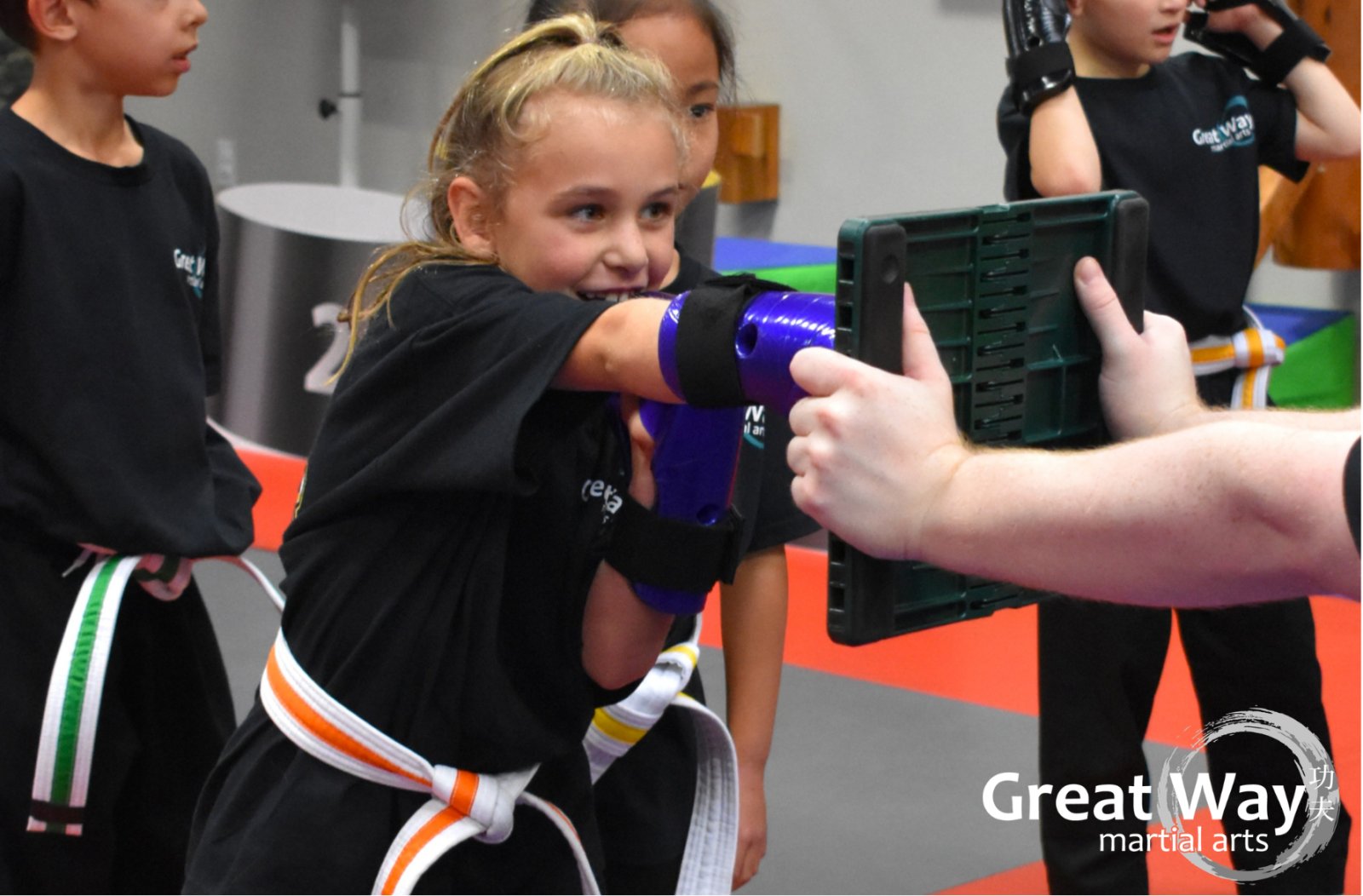
6 year old student breaking a board as part of the 2025 Youth Warrior challenge.
Here is how our approach works:
- Small steps, clear goals. Each skill builds on the last, so kids always know what to aim for.
- Calm, structured classes. Fewer distractions mean more room to pay attention.
- No competitions or tournaments. Without ranking pressure, anxious kids relax and engage.
- Every learning style. Our method caters to visual, auditory, and kinesthetic learners.
- Career instructors. Our full-time, career instructors guide each class.
For families comparing styles and teaching approaches, our guide on martial arts schools for kids covers what to look for. You can also see all our programs in one place to find the right age group, from Kung Fu Cubs (Ages 4-5) | Dragons (Ages 6-7) through Champions Kung Fu (Ages 8-11) to our teen classes.
What Your Child Needs | How Structured Martial Arts Helps | Why It Matters |
|---|---|---|
Clear goals | Small, step-by-step skill targets | Kids know what to focus on |
Calm setting | Structured, low-distraction classes | Less sensory overload |
Confidence | Effort-based praise, no ranking | Anxious kids relax |
Routine | Consistent instructors and classes | Focus becomes a habit |
Book a Trial Class and See Focus in Action
The fastest way to know if structured training fits your child is to try it. We offer year-round registration and welcome beginners.
If you have been looking for martial arts for kids in Kelowna, come see how a calm, goal-driven class feels.
Frequently Asked Questions
Why does my child lose focus during sports?
Kids lose focus for several reasons: attention spans are still developing, bright and noisy environments compete for their attention, and pressure to perform can make them tense. Some children also process instructions differently and need visual or hands-on cues rather than verbal ones. If your child focus during sports fades mostly in high-pressure moments, anxiety may be a factor worth exploring with a coach or health professional.
Is it normal for children to get distracted during sports?
Yes. Short attention spans are developmentally normal, especially for kids under eight. A child gets distracted during sports because their brain is still learning to filter noise, manage excitement, and hold a task in mind. Consistent structure, short instructions, and activities that match their learning style help most children improve over time without pressure.
What are good focus games for kids?
Simple games that require listening and quick reactions work well: freeze-and-go games, mirroring a partner's movements, balancing challenges, and memory sequences. Martial arts drills like stance holds and pad work are also excellent focus games for kids because they combine movement with a clear target. Keep sessions short, celebrate effort, and repeat the same games so kids build confidence.
When should I talk to a health professional about my child's attention?
Consider speaking with your family doctor or a pediatric professional if focus problems are persistent across school, home, and sports, if they affect your child's safety, or if your child seems distressed. A professional can rule out vision, hearing, or anxiety-related causes. In the meantime, structured activities with clear routines, like martial arts classes, can support attention and confidence in a low-pressure setting.
Your child's focus struggles are not a dead end. They are a signal that the setting needs to match how your child learns. Great Way Martial Arts has served Kelowna families since 1993 with career instructors, a goal-setting system, and Brain Gym and Mindset Training, all in a competition-free space where kids build focus without pressure. Get started with Great Way Martial Arts and watch your child's attention grow, one small win at a time.