Martial Arts for Visual Learners: A Parent's Guide
Table of Contents
- Why Martial Arts for Visual Learners Works So Well
- Key Martial Arts Benefits for Kids Who Learn by Watching
- The Benefits of Brain Gym for Students in Martial Arts
- How Instructors Adapt Teaching for Visual Learners
- Choosing Martial Arts Classes in Kelowna for a Visual Learner
- Common Mistakes Parents Make When Picking a Program
- Conclusion
- Frequently Asked Questions
Last Updated: September 26, 2026
Why Martial Arts for Visual Learners Works So Well
Martial arts for visual learners works because most techniques are taught by showing, not telling. A child who struggles to follow a spoken explanation often copies a demonstrated move within seconds. At Great Way Martial Arts in Kelowna, BC, we have taught since 1993 and built our method around this simple fact.
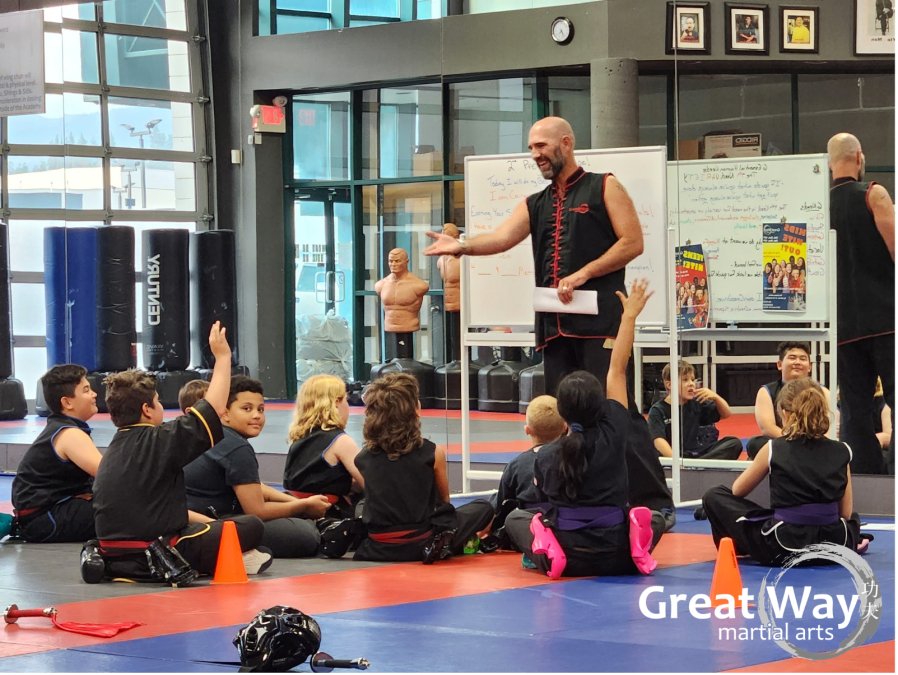
Think about how a typical class runs. The instructor faces the group and performs a punch, a block, or a stance. Kids watch, then copy. That is visual learning in its purest form.
How Visual Learners Process Instruction Differently
Visual learners are people who absorb and remember information best when they see it demonstrated rather than hear it described. They think in pictures, not paragraphs.
A verbal instruction like "pivot your back foot and rotate your hip" means little to a six-year-old. A slow demonstration of the same move makes sense right away.
Here is what that looks like in daily life:
- They copy what they see, not what they hear
- They remember faces and places better than names
- They notice small details in body position
- They get frustrated when told to "just listen"
- They learn faster from a mirror than from a lecture
Many parents describe their child as "not a good listener." Often, the child is simply a strong visual learner stuck in a hearing-first classroom.
Key Martial Arts Benefits for Kids Who Learn by Watching
The benefits of martial arts for kids who learn visually show up fast, because the teaching style matches how their brain already works. Confidence usually comes first, then focus.
A child who finally "gets" a move after watching it feels capable. That feeling builds week after week. Unlike team sports, progress does not depend on being picked or being the fastest.
Other gains parents notice:
- Better focus at school as kids practice watching closely
- More self-control as they learn to pause and copy with care
- Respect for instructors and training partners
- Physical fitness through varied movement, not repetitive drills
Confidence and Focus That Carry Into School
Confidence from martial arts tends to follow kids into the classroom. A child who can stand tall and speak up in the training hall often does the same at school.
Focus works the same way. Watching a demonstration takes real attention. Kids practice that skill every single class, and it becomes a habit they carry with them.
The Benefits of Brain Gym for Students in Martial Arts
The benefits of Brain Gym for students come from simple movement patterns that help the two sides of the body work together. These short exercises can sharpen focus and calm nerves before training or tests.
Brain Gym is a set of easy movements, like crossing arms and legs or touching opposite knees. Teachers use it to help students settle and concentrate. In a martial arts class, it fits naturally, because the whole session is movement-based.
A common routine before class might look like this:
- Cross-limb movements to wake up both sides of the body
- Slow breathing to settle busy minds
- Balance poses to build body awareness
- Simple copying games to warm up the eyes and hands
Parents often ask how this shows up at home. The clearest sign is a child who can calm down faster after a busy day. Another is a child who follows multi-step instructions without getting lost halfway through.
How Instructors Adapt Teaching for Visual Learners
Instructors adapt by showing every skill before asking students to try it, then using clear visual cues to guide the movement. A good instructor never relies on words alone.
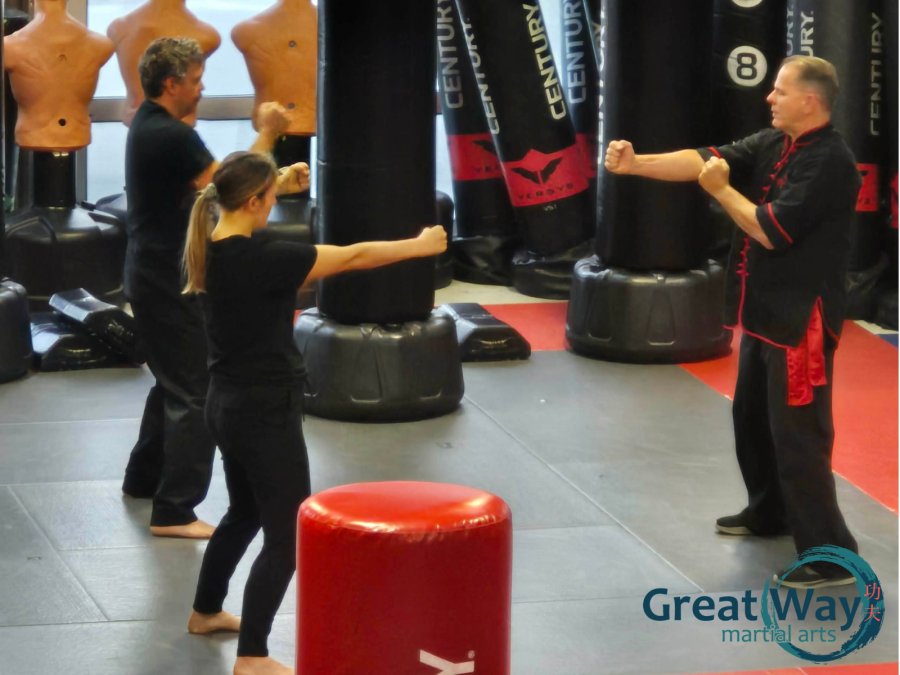
Martial arts instructor demonstrating a Wing Chun punch to two Great Way Martial Arts students as they practice martial arts techniques.
Refining these observational skills allows students to process complex movements more efficiently, ultimately strengthening the connection between athletic visual performance and overall physical coordination.
A common mistake in martial arts teaching is talking too much. Kids tune out after about two sentences of explanation. The best instructors cut the talk and increase the showing.
Mirroring, Demonstration, and Visual Cues
Mirroring means the instructor faces the class and moves as if looking in a mirror, so students copy left and right without confusion. It is one of the oldest teaching tools in martial arts, and it still works best.
Visual cues do the rest. A raised hand might mean "freeze." A pointed finger might mean "watch your foot." Over time, students read these signals without a single spoken word.
Here is how a strong visual lesson breaks down:
- The instructor demonstrates the full move at normal speed
- The move is shown again, slowly, with key points pointed out
- Students copy while watching the instructor in the mirror position
- The instructor corrects with gestures, not speeches
- Students practice in pairs while the instructor walks the room
At Great Way Martial Arts, our career instructors teach to visual, auditory, and kinesthetic learners in the same class. That means a child who learns by watching is never left behind.
Choosing Martial Arts Classes in Kelowna for a Visual Learner
Choosing martial arts classes in Kelowna for a visual learner comes down to watching one class before you commit. Look at how much the instructor demonstrates versus how much they talk.
When you visit a school near me, watch for these signs:
What to Watch | Strong Sign | Warning Sign |
|---|---|---|
Demonstration | Instructor shows every move | Mostly verbal explanation |
Class size | Small groups with hands-on help | Large groups, little correction |
Pace | Varied, with time to copy | Rushed, one move after another |
Instructor stay | Same faces year after year | High staff turnover |
Environment | Supportive, no pressure to compete | Push toward tournaments |
Great Way Martial Arts has served Kelowna families since 1993, and our instructors build careers here, not short stints. We work with Kids Sport Canada, Pacific Sport Okanagan, and Xplore Sports Camps, and we run a unique program through the Rotary Centre for the Arts. Our classes stay competition-free, so kids grow at their own pace.
Programs run by age, from Kung Fu Cubs (Ages 4-5) | Dragons (Ages 6-7) up to Teen Martal Arts and adult classes. Pricing depends on the program and schedule, so check our website for current rates.
Common Mistakes Parents Make When Picking a Program
The biggest mistake parents make is picking a school by location or price alone. A class five minutes away that talks instead of shows will not work for a visual learner.
Other common missteps:
- Assuming all martial arts classes teach the same way
- Signing a long contract before watching a single class
- Choosing a competition-focused school for a child who just wants to learn
- Ignoring how long instructors actually stay at the school
- Skipping the trial class because the website looked good
The fix is simple. Watch a class. Ask how instructors handle a child who learns by watching. Ask how long the teachers have been there.
Conclusion
Finding the right fit matters more than finding the closest gym. A visual learner thrives when an instructor demonstrates first and explains second, and that style is not universal. Great Way Martial Arts builds every class around visual, auditory, and kinesthetic learning, with career instructors, Brain Gym, and Mindset Training, all in a competition-free space in Kelowna. Get started with Great Way Martial Arts and watch your child's confidence grow, one demonstration at a time.
Frequently Asked Questions
How do martial arts instructors accommodate visual learners?
Instructors who teach martial arts for visual learners rely on demonstration over verbal explanation. They stand where students can see clearly, break each technique into slow, repeatable movements, and use mirroring so students copy what they see. Visual cues like hand signals, floor markers, and wall charts reinforce each step. At Great Way Martial Arts, career instructors are trained to teach across visual, auditory, and kinesthetic styles, so a child who learns by watching gets the demonstration they need before being asked to perform.
Are martial arts good for children who learn visually?
Yes. Martial arts is a highly visual discipline: every form, stance, and strike is learned by watching and copying. For a visual learner, that matches how they naturally absorb information. Research on the benefits of Brain Gym for students also shows that movement-based activities support focus and coordination. The combination of watching a technique, then physically repeating it, helps visual learners build confidence faster because they can see their own progress in the mirror and in their instructor's feedback.
Can martial arts help improve focus in visual learners?
Many parents notice focus improvements because martial arts requires sustained attention: a student must watch closely to copy a technique correctly. Brain Gym activities, which Great Way Martial Arts incorporates into its curriculum, use movement to engage both sides of the body and support concentration. For a visual learner who gets distracted by words alone, having something to watch and imitate keeps their attention anchored. Progress is tracked through a goal-setting system, so kids see measurable improvement over time.
How does Great Way Martial Arts support different learning styles?
Great Way Martial Arts has taught in Kelowna since 1993 and builds its curriculum around visual, auditory, and kinesthetic learning styles. Instructors demonstrate techniques visually, explain them verbally, and guide students through hands-on repetition. The program also uses Brain Gym and Mindset Training to support self-control and focus. Classes are competition-free, so children who feel pressured by tournaments can progress at their own pace. Programs are grouped by age, from Kung Fu Cubs (ages 4-5) through Teen Martial Arts (ages 12-16).