How to Learn Martial Arts Without Sparring: A Beginner Guide
Table of Contents
- Why You Can Learn Martial Arts Without Sparring
- Martial Arts Training Without Contact: How Skill Actually Builds
- Martial Arts Practice at Home for Beginners: Setting Up Your Space
- Wing Chun Drills for Beginners You Can Do Solo
- Building a Beginner Martial Arts Training Plan
- How to Find a Beginner-Friendly Wing Chun School
- Common Mistakes to Avoid When Learning Without Sparring
- Conclusion
- Frequently Asked Questions
Last Updated: October 17, 2026
Why You Can Learn Martial Arts Without Sparring
You can learn martial arts without sparring. Sparring is one training method, not the art itself. Plenty of students build real skill through forms, drills, and partner work that never turns into free fighting.
At Great Way Martial Arts in Kelowna, BC, we have taught Wing Chun this way since 1993. Our classes are beginner friendly and registration stays open year round.
Here is the part most guides get wrong: they treat sparring as the finish line. It isn't. Sparring tests a narrow slice of skill under pressure. It does not teach structure, timing, or control. Those come from repetition.
So what does a no-sparring path look like?
- Forms teach you where your body goes and why.
- Drills build reactions against a partner's arms or a bag.
- Slow partner work lets you feel pressure without getting hit.
You lose nothing essential. You gain a training style you can keep up for decades.
Martial Arts Training Without Contact: How Skill Actually Builds
Skill in martial arts without sparring builds through three layers: shape, sensitivity, and timing. Shape is your stance and structure. Sensitivity is reading force through touch. Timing is knowing when to move.
Wing Chun leans hard on the middle layer. Chi sau, often called sticky hands, is a partner drill where two people roll their forearms together and respond to pressure. No strikes land. No one gets hurt. Yet you learn more about balance and reaction than most people expect.
The National Coaching Certification Program frames skill this way too: athletes learn best in progressive steps, with feedback at each stage. Contact comes last, if it comes at all.
A common mistake is rushing to hit things. Beginners who skip structure spend years correcting bad habits.
Martial Arts Practice at Home for Beginners: Setting Up Your Space
You need about two square metres of clear floor, a mirror if you have one, and nothing else. That is the whole setup for martial arts practice at home for beginners.
Clear the space of trip hazards. Hard floor or low-pile carpet works better than thick rug. Wear flat shoes or train barefoot.
Keep sessions short. Fifteen focused minutes beats an hour of drifting. Aim for three or four sessions a week.
What to practice at home:
- Your stance, held for one minute at a time
- The first section of your form, slowly
- Single techniques, twenty reps each side
- Slow stepping drills
Skip anything that needs a partner. Save that for class.
Wing Chun Drills for Beginners You Can Do Solo
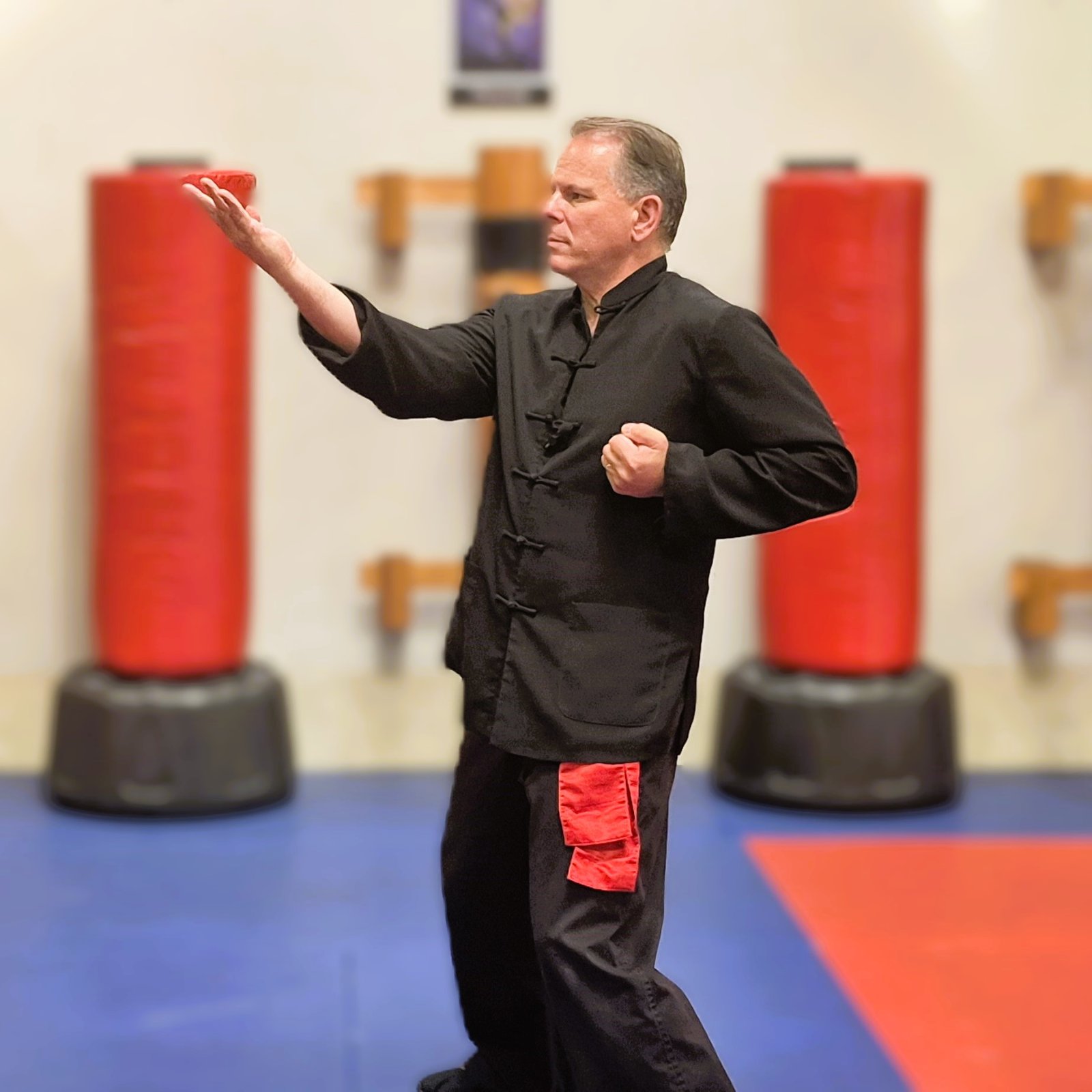
A beginner practicing a slow Wing Chun form in a bright, tidy living room with a mirror and open floor space, focused and calm
Solo Wing Chun drills for beginners train structure and relaxation, and you can run all of them in a small room.
Start with the basic stance. Feet shoulder width, knees soft, weight settled. Hold it and breathe. Check that your shoulders stay down.
Then run the first form slowly. Wing Chun's opening form is done at a crawl on purpose. Speed hides mistakes. Slowness exposes them.
Add these:
- Chain punches in the air, relaxed, twenty per side
- Tan sau and bong sau rotations, slow and deliberate
- Step-and-punch drills across the room
- Pivot drills to train your turning
Ten minutes of slow work does more than thirty minutes of fast, sloppy reps.
Building a Beginner Martial Arts Training Plan
A beginner martial arts training plan works best at three short sessions a week, plus one class. Consistency beats intensity every time.
Here is a simple weekly frame:
Day | Focus | Time |
|---|---|---|
Monday | Stance and first form | 15 min |
Wednesday | Solo drills and pivots | 15 min |
Friday | Form review, slow | 15 min |
Weekend | Class or partner work | 60 min |
Track what you practice. A notebook beats memory.
How to Find a Beginner-Friendly Wing Chun School
Look for a school that separates beginners from advanced students and teaches structure before contact. Ask three questions before you sign up.
- Do beginners train in their own group?
- Is sparring optional or absent?
- Do instructors stay long term?
That last one matters more than people think. A school with steady career instructors gives your child or you a stable relationship. Great Way Martial Arts has kept full-time instructors on staff for decades, and we build every class around a goal-setting system so students see progress.
Ask about class format too. If you or your child learns best by watching, hearing, or doing, the teaching should adapt. Ours does, through visual, auditory, and kinesthetic methods.
If you are searching for martial arts classes near me in Kelowna, visit in person. Watch a class. Talk to parents in the lobby.
Common Mistakes to Avoid When Learning Without Sparring
The biggest mistake is treating no-sparring training as easy training. It isn't. It asks for more patience, not less.
Watch for these:
- Skipping the basics to learn flashy techniques
- Training fast before your structure is solid
- Practicing alone only, never testing against a partner
- Chasing belts instead of skill
- Quitting at the first plateau
Plateaus are normal. They usually mean your body is consolidating what you learned.
Conclusion
Learning martial arts without sparring is a real path, and for many people it is the better one. You build structure, sensitivity, and timing at your own pace, with less risk and more staying power.
At Great Way Martial Arts, we teach Wing Chun and Kung Fu in a competition-free setting. Our career instructors use a goal-setting system, Brain Gym, and mindset training to build focus and confidence. Registration is open year round, and beginners are welcome at any age. Adults can explore Traditional Wing Chun For Adults or the slower, balance-focused work of Tai Chi For Adults, both taught without sparring.
Get started with Great Way Martial Arts and build skill that lasts a lifetime.
Frequently Asked Questions
Can you really learn martial arts without sparring?
Yes. Sparring is one training method, not a requirement for building skill. Forms, solo drills, pad work, and partner exercises with controlled contact teach stance, structure, timing, and technique. Many traditional styles, including Wing Chun, build competence through repetition and sensitivity drills before any free fighting. A school that skips sparring can still develop real self-defense ability, especially for beginners who want fitness, focus, and confidence first.
Can you learn Wing Chun without sparring?
Wing Chun suits non-sparring practice well because it centers on forms, chi sau sensitivity drills, and structured partner work. Beginners start with stance, centerline theory, and slow solo forms. At a school like Great Way Martial Arts in Kelowna, classes are competition-free, so progress comes from technique and control rather than free fighting. You can also practice Wing Chun drills for beginners at home to reinforce what you learn in class.
How can beginners practice martial arts safely on their own?
Clear a space of at least two square metres, warm up for five to ten minutes, and start with slow, controlled movements. Focus on stance and posture before speed. Use a mirror to check alignment, keep sessions to 15-20 minutes at first, and stop if you feel joint pain. A beginner martial arts training plan that alternates forms, footwork, and light conditioning reduces strain. Check with a doctor before starting if you have existing injuries.
What can you learn in martial arts classes besides sparring?
Classes cover far more than fighting. You can build stance and footwork, learn forms and sequences, practice pad work, develop balance and coordination, and train focus through goal-setting. Many schools also teach breathing, mindset, and stress relief. At Great Way Martial Arts, the curriculum blends Wing Chun, fitness, and character development, so students gain discipline and confidence without contact drills or tournaments.