7 Ways Martial Arts Helps Teen Focus (Backed by Science)
Last Updated: November 5, 2026
Quick Summary
Yes, martial arts and focus are closely linked for teens. Training builds sustained attention through repetitive drills, forms, and partner work that reward concentration and make distraction feel immediately wrong. Focus behaves like a trainable muscle, not a fixed trait.
- Wing Chun forms and chi sau drills train sustained and selective attention deliberately.
- The Teen Martial Arts program for ages 12-16 is competition-free, so progress is the only scoreboard.
- Track task initiation by counting how many reminders it takes to start homework each week.
- Neurodivergent teens often thrive with short, clear instructions and the same class sequence every time.
- Great Way Martial Arts has taught teens in Kelowna since 1993 with career instructors.
Table of Contents
- Why Teen Focus Feels Harder Than Ever
- The Link Between Physical Movement and Teen Cognitive Function
- How Martial Arts and Concentration Work Together
- Martial Arts for Focus and Discipline: Building Self-Control That Sticks
- Why Martial Arts for Teens Beats Traditional After-School Activities
- Martial Arts and School Focus: Transferring Dojo Skills to the Classroom
- Focus Strategies for Neurodivergent Teens
- The Digital Detox Angle: Trading Screens for Structure
- Frequently Asked Questions
Why Teen Focus Feels Harder Than Ever
Teen attention is under more strain than at any point in recent memory. Phones buzz every few minutes, school demands are heavier, and the quiet space to think has shrunk. Parents in Kelowna ask us the same question constantly: what is the link between martial arts and focus for teens?
At Great Way Martial Arts, we have taught teens in Kelowna since 1993. Focus is the skill parents mention most when they enroll. Below, we break down seven ways training builds it, plus what to expect in the first months.
Here is the core idea: focus is trainable. It behaves like a muscle, not a fixed trait.
The Link Between Physical Movement and Teen Cognitive Function
Movement changes how the brain works, and the teen years are when that matters most. The adolescent brain is still pruning and strengthening neural pathways, so the inputs it gets, sleep, stress, screens, and physical activity, shape attention circuits for years. The Canadian Society for Exercise Physiology guidelines note that regular activity supports mental health and cognitive function across the lifespan, including the teen years. The ParticipACTION Report Card on Physical Activity for Children and Youth has repeatedly flagged that most Canadian teens fall short of movement guidelines, which is one reason focus complaints are so common.
What does that mean in plain terms?
- Exercise can help alertness for a window after training, and many teens find they settle into homework more easily after activity than after sitting still
- Movement supports mental clarity during class time by giving the brain a predictable outlet for restlessness
- Regular activity helps stress management, and stress is one of the biggest thieves of teen attention, a teen worried about a math test is not a teen who can focus on a form
Why Wing Chun Specifically Fits the Teen Brain
Not all movement is equal for attention. Open-skill sports, where the environment changes constantly, train reactive attention. Closed-skill practice, like Wing Chun forms and chi sau drills, trains sustained and selective attention. Both matter, but the closed-skill side is where focus is built deliberately.
Wing Chun adds elements that generic fitness may not include:
- Relaxed structure. The centerline principle and the relaxed-tension balance teach a teen to stay calm under pressure rather than muscle through it. That is the same skill as staying calm during a timed test.
- Close-range awareness. Chi sau (sticky hands) requires tracking a partner's pressure and intent in real time. A teen cannot drift off during chi sau without immediately feeling it.
- Repeatable forms. Siu Nim Tau and the other forms are practiced the same way every class, which gives the brain a predictable sequence to anchor attention to, the opposite of a scrolling feed.
The Mechanism in Plain Language
When a teen moves with intention, holding a stance, tracking a partner, repeating a form, several things happen at once. Blood flow to the brain increases. The vestibular and proprioceptive systems get clear input, which helps the brain know where the body is. And the prefrontal cortex, the part responsible for planning and impulse control, gets practice staying online while the body is busy.
That is the practical case for martial arts over another screen-based activity. You are not asking a teen to resist distraction through willpower. You are giving the brain a task that rewards attention and makes distraction feel immediately wrong.
How Martial Arts and Concentration Work Together
A student repeats a stance, a strike, or a form until the body stops needing instructions. Readers who want to know what teens actually train and how the curriculum builds focus over time can explore the martial arts curriculum for teens. That repetition is where attention span grows.
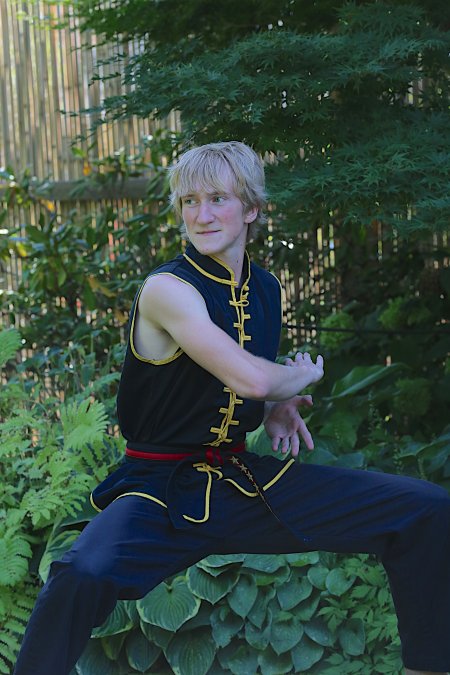
The same deliberate attention to stance, timing, and controlled movement can carry into after-school boxing benefits, where focused practice gives teens another way to strengthen concentration.
Repetitive Drills Build Attention Span
Drills look simple from the outside. Inside, the student is tracking foot position, hand height, breathing, and timing all at once. Miss one detail and the movement falls apart.
That is sustained attention in practice.
Sensory Processing and Physical Coordination
Some teens process the world differently. Loud rooms, busy hallways, and fast instructions overwhelm them. Training helps here because it pairs movement with clear sensory input.
Martial Arts for Focus and Discipline: Building Self-Control That Sticks
Discipline is not something we hand students. It is something they build by showing up. Martial arts for focus and discipline works because the structure is visible: bow in, follow the sequence, wait your turn, finish the drill.
Self-control grows in small, repeatable steps:
- Waiting for a partner instead of rushing ahead
- Holding a position when it gets uncomfortable
- Restarting a form after a mistake without frustration
Why Martial Arts for Teens Beats Traditional After-School Activities
Here is how it compares:
Activity | What It Builds | Progress Tracking | Competition Pressure |
|---|---|---|---|
Team sports | Fitness, teamwork | Team standings | High |
Tutoring | Academic skills | Test scores | Moderate |
Martial arts training | Focus, self-control, fitness | Belt and skill goals | None required |
Screen time at home | Very little | None | None |
Our Teen Martial Arts (Ages 12-16) program is competition-free. Parents who want to see the actual program can explore the teen martial arts program.
Martial Arts and School Focus: Transferring Dojo Skills to the Classroom
Martial arts and school focus connect through routine and goal setting. A teen who sets a belt goal learns to break a big target into weekly steps. That is the same skill behind finishing a term paper without a last-minute scramble.
Goal Setting and Executive Function
Executive function covers planning, starting tasks, and managing impulses (Executive functioning). Teens with stronger executive function tend to handle homework with less friction.
Our instructors use a systematized goal-setting system so students can see their next target.
Ready to see it in person? Book a teen trial class and watch how your teen responds to a structured session.
Focus Strategies for Neurodivergent Teens
Some teens need a different on-ramp to focus. Neurodivergent students, including teens with ADHD, autism, or sensory processing differences, often thrive in structured environments where expectations are clear and predictable. Wing Chun training may suit some neurodivergent students because classes follow a consistent structure.
Strategies that help, and how they show up in a Wing Chun class:
- Short, clear instructions with one task at a time. Instead of "do the form," an instructor might say "hold the stance, then the first three moves." Chunking is built into how Wing Chun is taught.
- Visual demonstration before verbal explanation. Hands-on instruction means the instructor often shows the movement, then the student mirrors it.
- Predictable routines so the student knows what comes next. The bow-in, warm-up, forms, drills, and bow-out sequence is the same every class. For a teen whose brain is constantly scanning for what is coming, that predictability is calming.
- Movement breaks built into the session. Wing Chun alternates standing practice with partner drills and footwork, so a teen is never asked to hold still for an hour.
- Reduced sensory load. No loud music, no flashing lights, no crowds. The room is quiet and the focus is on one partner at a time, which suits teens who find busy environments overwhelming.
Our teaching method caters to visual, auditory, and kinesthetic learning styles, which matters for teens who tune out from pure lecture. Parents who want a deeper look can read about non-competitive martial arts for neurodivergent children or check whether martial arts is good for ADHD children.
Watch out: a poor fit usually shows up as a teen shutting down during instructions, not as misbehavior.
How Parents Can Track Focus Progress at Home
Most articles tell parents to "watch for improvement" without saying what to watch. Here is a practical way to measure change in the first three months, using the same categories instructors use on the mat:
- Task initiation. Count how many reminders it takes to start homework. A teen who needed three reminders in week one and needs one by week eight is showing transfer.
- Sustained attention. Time how long a teen can read or practice a form before reaching for a phone. Track it weekly; the trend matters more than any single day.
- Frustration recovery. Notice how quickly a teen resets after a mistake, a dropped form, a wrong answer, a lost game. Wing Chun teaches restarting without drama, and that shows up at home.
- Instruction retention. Ask a teen to explain one thing they learned in class. A teen who can describe a drill in their own words is a teen who was paying attention.
- Sleep and screen habits. Training nights often shift bedtime earlier and reduce late-night scrolling. That is a focus benefit even if it is not the one parents expected.
A simple notebook or phone note with one line per week is enough. Bring it to a parent-instructor conversation every month or two and the instructor can adjust the teaching approach to match what is happening at home. That feedback loop is the part most programs skip, and it is the part that makes focus gains stick.
The Digital Detox Angle: Trading Screens for Structure
An hour without a phone is a small thing. An hour without a phone where the teen is moving, concentrating, and being watched by a coach is something else.
That is the practical case for martial arts for focus and discipline over another screen-based activity. You are not asking a teen to resist distraction through willpower. You are removing the distraction and replacing it with a task.
Teen focus does not fix itself, and it rarely improves through lectures about willpower. It improves through repetition, structure, and a coach who notices. Great Way Martial Arts has taught in Kelowna since 1993 with career instructors, a systematized goal-setting system, and Brain Gym and Mindset Training.
Frequently Asked Questions
Does martial arts help teenagers improve their focus?
Yes. Martial arts training combines physical movement with mental concentration, which strengthens the brain's ability to sustain attention. Research on physical activity and cognitive function shows that regular exercise improves executive function, the set of mental skills that include focus, impulse control, and working memory. In a martial arts class, teens practice holding stances, following multi-step instructions, and repeating drills, all of which train the brain to stay present.
How can martial arts training help teens with concentration at school?
Martial arts and school focus connect through shared skills: listening carefully, following directions, and managing impulses. In class, teens learn to watch an instructor, process the instruction, and execute a technique, which mirrors classroom listening. The structured environment of a dojo also teaches teens to sit still, wait their turn, and persist through challenges. The key is repetition and a program that reinforces these skills explicitly.
Is martial arts suitable for a teen who struggles to pay attention?
It can be, especially when the program is designed for different learning styles. Look for instructors who use visual demonstrations, verbal cues, and hands-on practice, and who break skills into small, achievable steps. A supportive, non-competitive environment helps teens who feel anxious about failure. Talk to the instructor about your teen's needs before enrolling so they can adapt their teaching approach.
What should parents look for in a martial arts program for teens?
Prioritize programs with experienced, career instructors who stay long-term, a clear goal-setting system, and a non-competitive atmosphere. Ask about class structure, how instructors handle different learning styles, and whether they offer progress tracking. Visit a class to see if teens are engaged and supported. A good program emphasizes personal growth, self-discipline, and confidence rather than tournaments. Also confirm the schedule fits your teen's routine and that the environment feels welcoming to beginners.